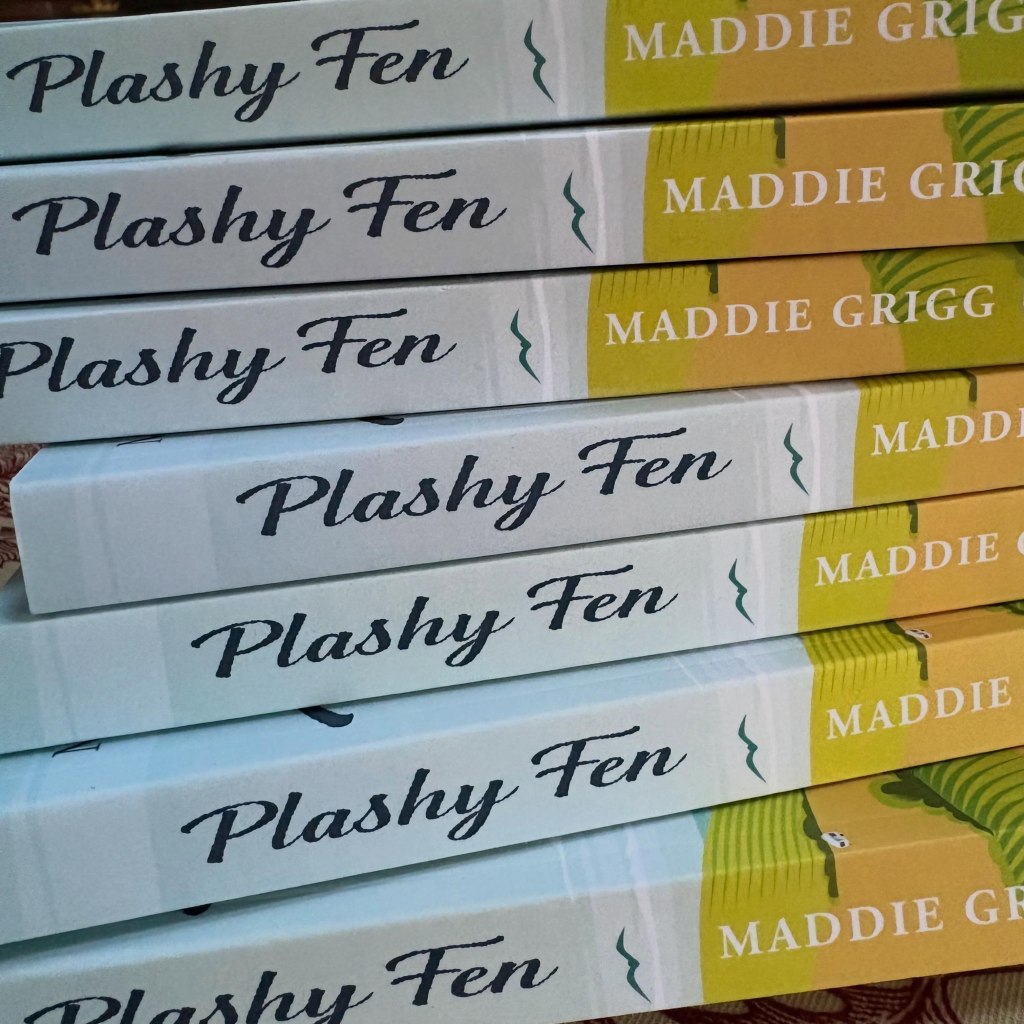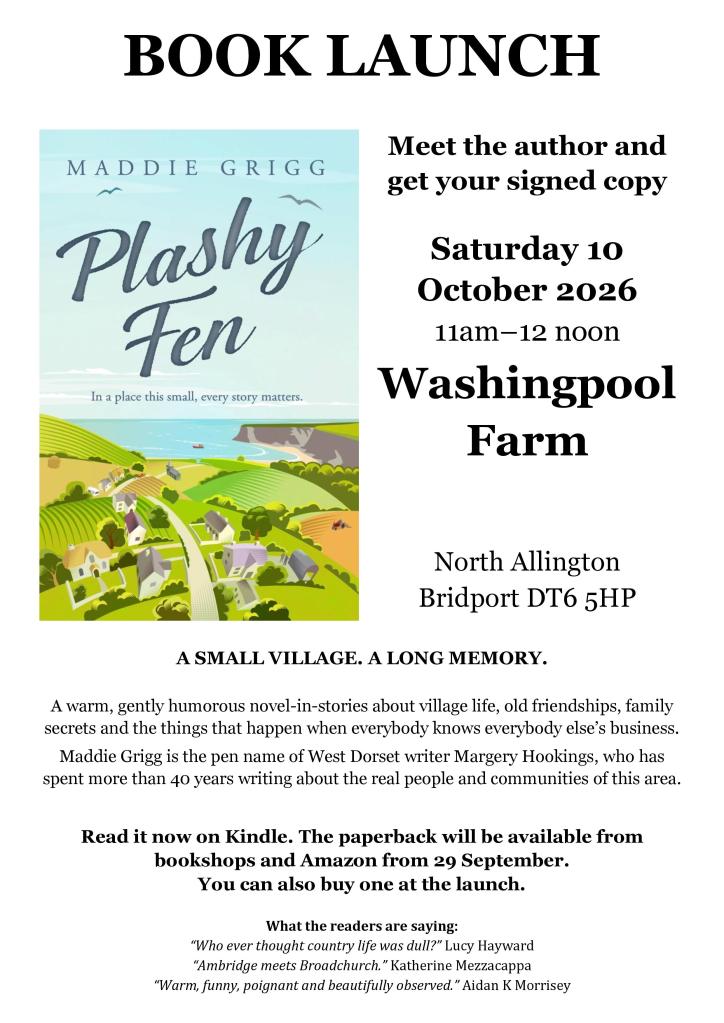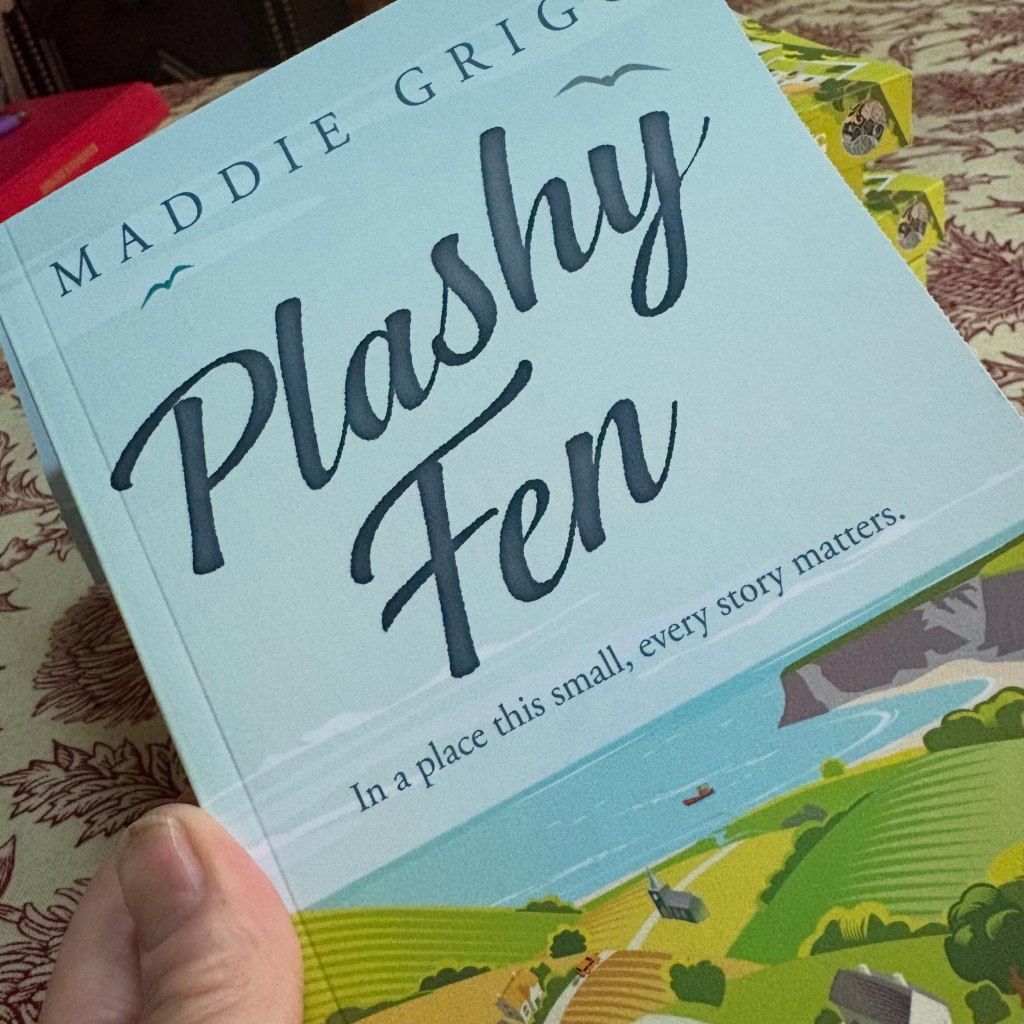
The title of my new novel, Plashy Fen, came to me in the middle of the night a few years ago.
I wasn’t happy with the working title I’d given it, as who the hell did I think I was, calling it Dylan’s Wake, in a nod to the author of the wonderful Under Milk Wood, which is one of my favourite books.
And anyway, early beta readers told me they thought it was going to be about the funeral party of someone called Dylan.
I’ve been writing a column for The People’s Friend for over a decade now, after the then editor emailed me out of the blue telling me she’d seen my blog, The World From My Window, and would I like to write for the magazine?
She said (and it’s etched in my mind): ‘I think you might just be the writer we’ve been looking for! I like your ability to write with humour about the minutiae of daily life, but with a touch of emotional depth, too.’
So I introduced my village to Friend readers as Lush Places, named after the fictional newspaper column by the hapless and fictional nature writer William Boot, who, through a case of mistaken identity, becomes a war correspondent for The Daily Beast.
Lush Places from Bluebell Hill
Boot is the main character in Scoop by Evelyn Waugh, which was published in 1938. It’s dated now and very politically incorrect but I loved the juxtaposition of a naïve, gentle writer in the cut-and-thrust world of horrid Fleet Street hacks out to make a name for themselves in a forgotten corner of the world.
I was redrafting my latest novel about Lush Places’s seaside sibling when the new village’s name – and book title – came to me during the early hours of the morning.
There is a line in one of Boot’s nature columns – ‘feather-footed through the plashy fen passes the questing vole’ – which has come to signify an affected style when it comes to nature writing.
I guess the the term plashy fen must have stuck with me. It’s become a bit of a personal joke and serves the purpose of making me check my prose style every now to make sure I’m not coming across as a complete jerk.
So that’s the story of how Plashy Fen got its name.
But the characters, well, they’re a different story…
The internet today is full of solar eclipse photographs.
Some of the best I’ve seen are not of the sun being eaten by the moon but the mottled crescent-shaped shadows created in the streets, in bedrooms and on furniture.
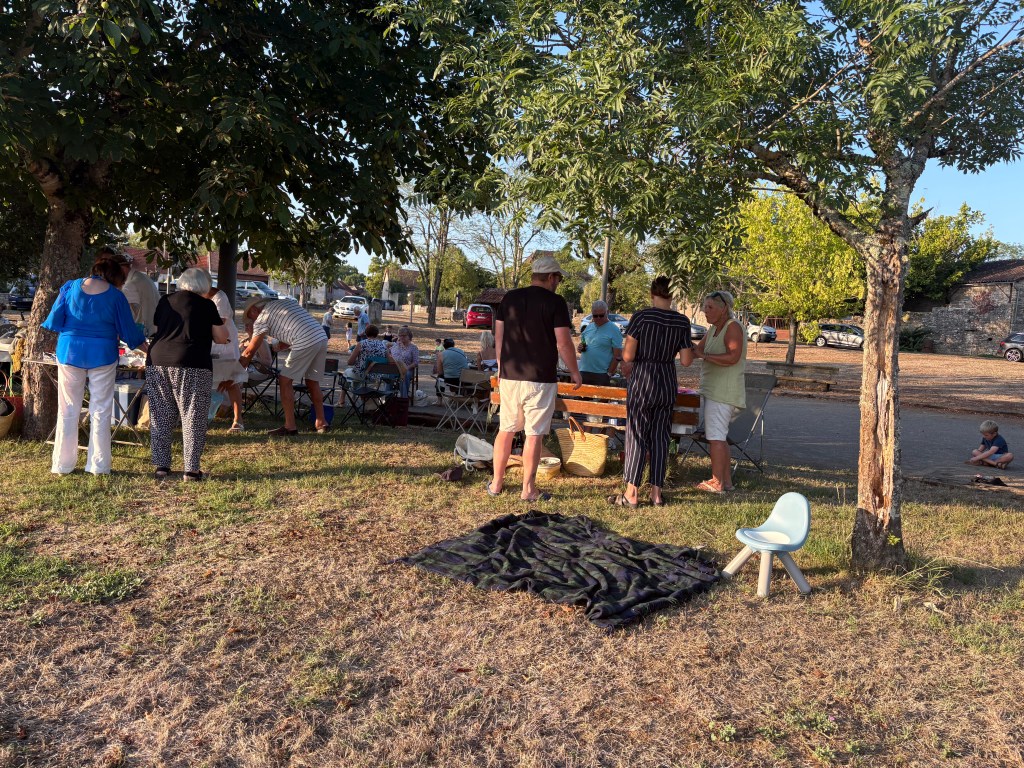
Here in south west France, we had a great view from the village boulodrome. Folk brought along food to share. Word had clearly got around that this was a good spot. Various groups, mostly French, sat in chairs and on picnic rugs to enjoy the spectacle.
When it came, the special eclipse glasses made it an incredible experience.
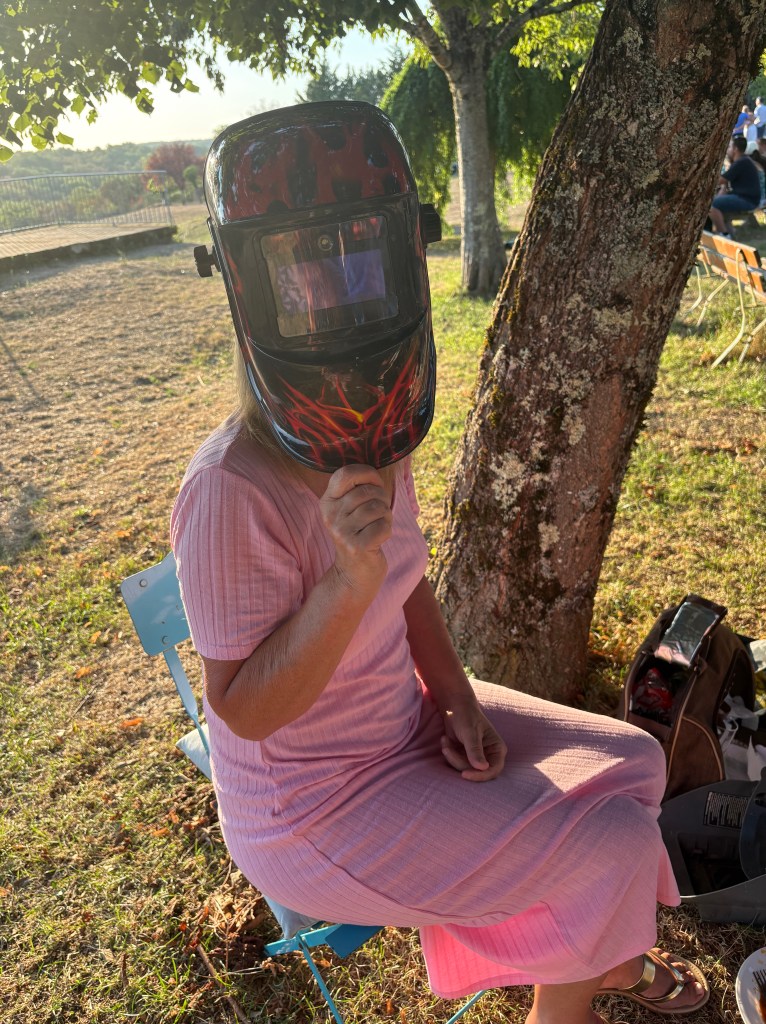
There were others using welding masks and goggles, as well as pinhole cameras made out of boxes.
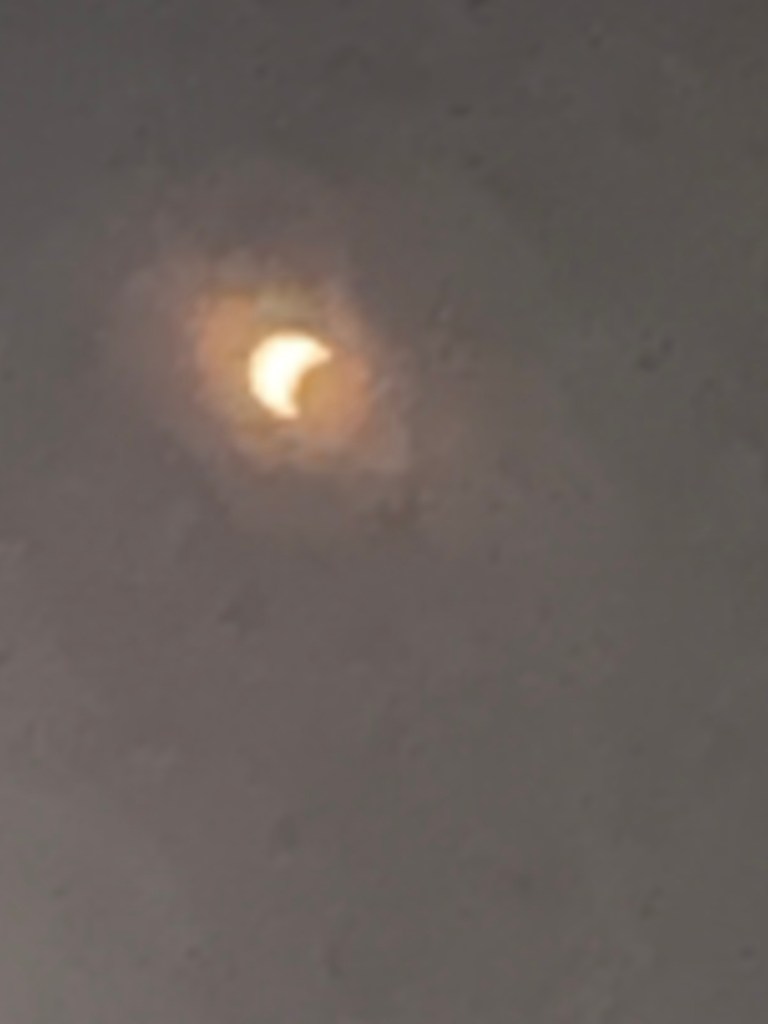
I managed to get the shot below by holding my eclipse glasses over the camera on my phone, early on in the process. Not the best image, but you get the picture.
Unlike in 1999, when the UK had a total eclipse, this one was only partial – about ninety seven or eight per cent for us.
It was humbling to appreciate the sun’s mighty force, even when its battery is drained to the last few percent.
It went a bit darker, but not like in 1999 when the eclipse was in the middle of the day rather than at sunset.
The streetlights didn’t come on this time, nor did the birds suddenly go quiet after coming into roost.
Still, it was shared experience and people in various countries enjoyed this natural phenomenon. Truly awesome, in the absolutely real sense of the word.
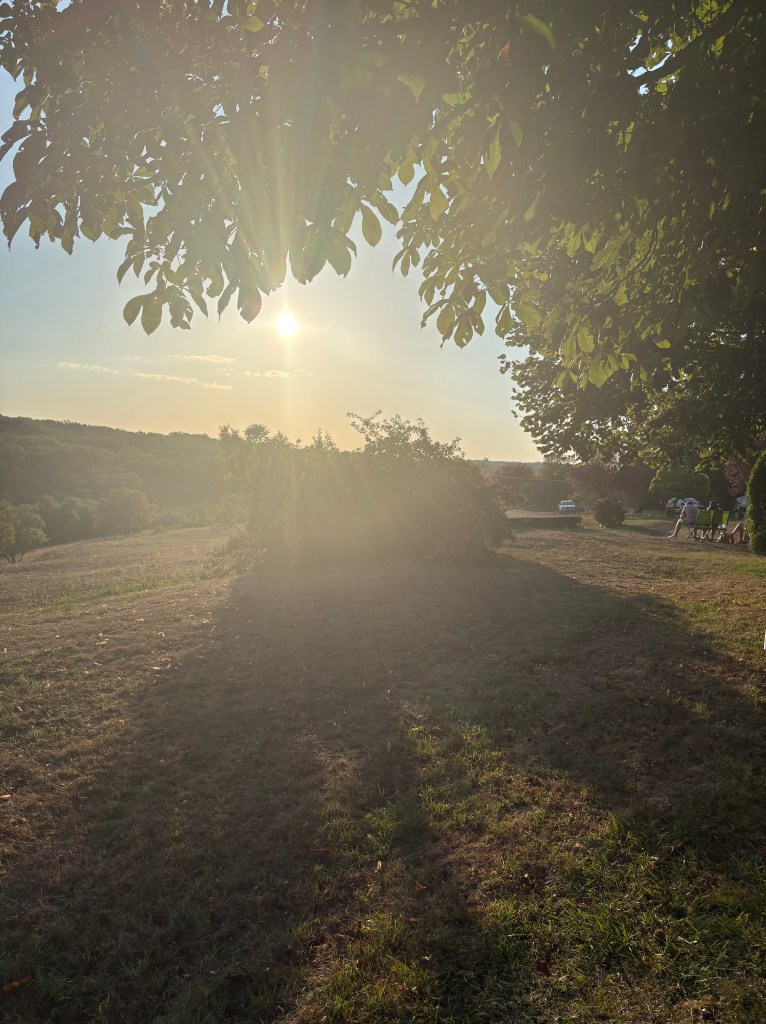
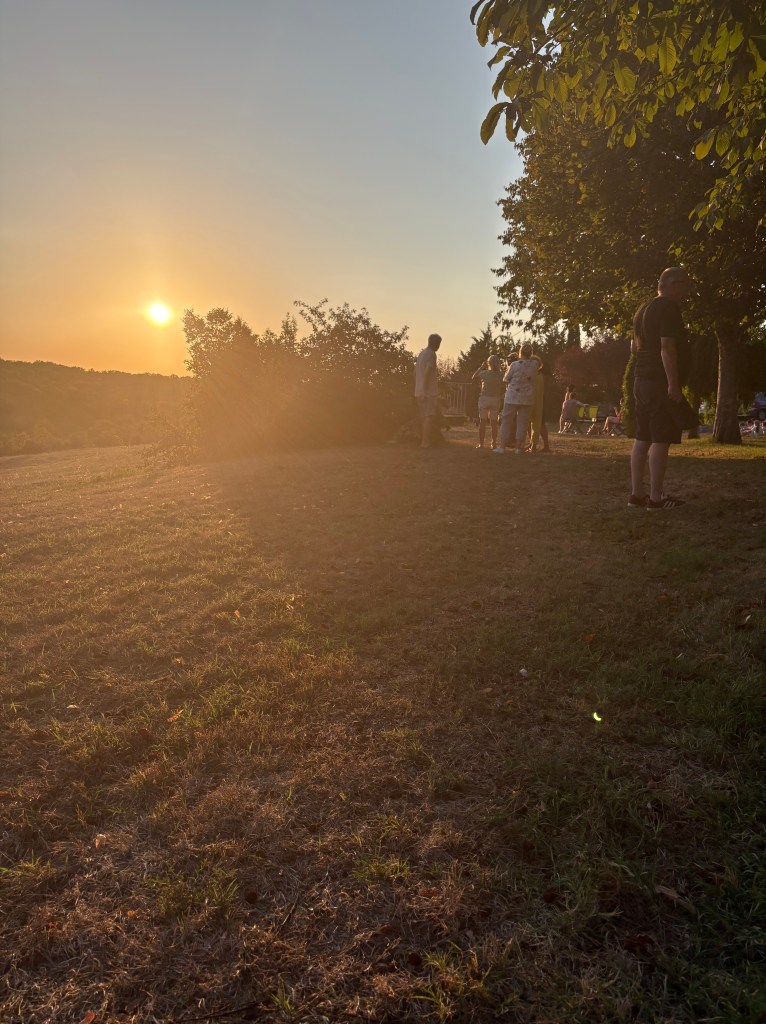
Sunset itself was pretty wonderful, too.
And then -much, much later – it wa the turn of the Perseids meteor shower, which was ‘like a movie’ according to one of my friends who just happened to wake at two-thirty in the morning and remembered to go outside and look at the sky.
We saw several shooting stars before we went to bed, but also so many fast-moving satellites, which were never really a part of the night sky when I was a young child in the 1960s.
Anyway, thank you, Sun and Moon, for forgetting your differences and coming together for such a spectacular occasion.
We’re off to see the new film, The Odyssey, on Monday night.
I’m very excited – and a bit relieved too.
It’s the kind of epic that needs to be seen on the big screen but I’m currently in south west France, so where to see it as VOST (original version with French subtitles)?
The town Cahors is about fifty minutes away but there’s a cinema there, the film is on so I’ve booked tickets to see it.
It tells the ancient Greek myth of Odysseus and his epic ten-year voyage from Troy to his island kingdom of Ithaka. I know know it’s a Hollywood blockbuster treatment of the story and the characters will all be speaking with American accents, but I really don’t care.
Homer’s Odyssey is, in my opinion, the greatest story ever told but it’s one of those movies that directors have shied away from making for far too long.
Director Christopher Nolan (Oppenheimer, The Dark Night and the wonderful Interstellar) has already caused controversy among people who haven’t even seen it yet, mainly because a Black woman (Lupita Nyong’o) has been cast as Helen of Troy.
The Odyssey is, of course, a classic Greek myth – probably grounded in some historical truth but lots of it made up and embellished along the way. It’s a story.
I suspect the ranting against the film tells us more about the people complaining and their lack of imagination than it does about the director’s casting choices.
And anyway, in Homer’s Odyssey, Helen doesn’t have much of a part to play – that’s all done and dusted in The Iliad (which was reflected in the film Troy, with Brad Pitt as Achilles and Sean Bean as the wily Odysseus rather than Matt Damon who takes the lead role in this latest film).
Greek mythology has been told and retold ever since ancient ‘Greek’ tribes first sat round a fire and listened to a storyteller taking them on a magical journey.
My first brush with Greek mythology was through Enid Blyton’s Tales of Long Ago, a literary gem (not) but, as a child, I loved it. The stories sparked an obsession with the ancient Greeks, leading me to quietly convince myself that Jason and the Argonauts was the best film of all time.
I loved this film!
Much later, as a confirmed landlubber, I learned how to sail so I could act as Mr Grigg’s first mate and potter around the Ionian just so I could feel part of ancient Greek mythology or at least its landscape.
He’d bought a share in a yacht called Nestor, the elderly warrior who features in both The Iliad and The Odyssey, in partnership with the aptly-named Odysseus Sailing.
Sailing towards the wild pig island of Atokos. I’m not sure where from, it could be Ithaca.
We – and family and friends – had many happy weeks over the years on this boat, until she sank in 2020 in a rare medicane – a tropical-like cyclone – called Ianos. She had been tied up to a jetty in Kioni, Ithaka. Luckily, we weren’t on her at the time and neither was the family that chartered her. But Nestor was unsalvageable.
Before then, in 2012, not long after Mr Grigg retired, we let our house in Dorset and went to live in Corfu for a year, close to the beach that lays claim to being the one where a naked Odysseus washed up and was taken in by Princess Nausicaa.
Sunset over Corfu.
Thanks to a laptop and an internet connection, I could carry on working and swan around during my coffee break, imagining myself in a diaphanous gown like a Greek goddess.
Blatant plug alert, I wrote a book about our twelve month adventure: Good Morning Corfu: A Year on a Greek Island. (Living the dream was great but not quite like I imagined. Be careful what you wish for.)
The view from our house in Corfu.
Later, we renamed our new rescue dog Artemis after the goddess of hunting, wild animals and nature and then wondered why she’d wander off in the olive groves at the first opportunity.
We’ve gone up the River Acheron (near Parga) towards the entrance to the Underworld. We ducked under a fence to visit the then-closed Necromanteion and imagined Odysseus summoning up the spirit of the blind prophet Tiresias to tell him how to get home.
We’ve visited the oracle at Delphi, the royal tombs at Vergina – the site of ancient Aigai, final resting place of Philip II, the father of Alexander the Great – and trudged up Mount Olympus almost as far as the Plateau of the Muses but were thwarted by deep snow.
We went on a cheap coach holiday to Turkey just so I could visit the site of Troy. We went on a similar tour to Sicily mainly for the Greek temples.
Mr Grigg knows I get much more excited wandering around a hot amphitheatre than going to a fancy restaurant.
In 2011, I even studied classics and ancient history at graduate level as a mature student. This was a mistake, to be fair, as I really struggled with learning ancient Greek. I was in over my head, the other students at Exeter University were way too clever and I realised with a heavy heart that I wasn’t up to it and that academia was just not my natural neighbourhood.
But I still love anything to do with Greek mythology. I’m particularly taken with modern interpretations and retelling, particularly novels by women like Margaret Attwood (The Penelopiad), Pat Barker (The Voyage Home) and Natalie Haynes (A Thousand Ships), and also Claire North and The Songs of Penelope trilogy.
My favourite poem is Ithaka by C P Cavafy, a metaphor for savouring life’s journey. I read it at my nephew’s wedding last year.
The Odyssey is an adventure story. It’s full of monsters, trials and tribulations, desire, determination, courage, folly and the burning need to get back home. There is something in it for everyone. And that’s the whole point.
The story has been – and will continue to be – presented in so many ways. This fantastic tale is kept alive by the retelling and reshaping.
There is no ‘right’ interpretation.
I hope I will enjoy this almost three-hour film on Monday. I’m sure I will as long as the seats are comfortable. I’ll just suspend my disbelief, immerse myself in a powerful soundtrack and let the story take me to Ithaca.