Why Plashy Fen?

The title of my new novel, Plashy Fen, came to me in the middle of the night a few years ago.

I wasn’t happy with the working title I’d given it, as who the hell did I think I was, calling it Dylan’s Wake, in a nod to the author of the wonderful Under Milk Wood, which is one of my favourite books.

And anyway, early beta readers told me they thought it was going to be about the funeral party of someone called Dylan.

I’ve been writing a column for The People’s Friend for over a decade now, after the then editor emailed me out of the blue telling me she’d seen my blog, The World From My Window, and would I like to write for the magazine?

She said (and it’s etched in my mind): ‘I think you might just be the writer we’ve been looking for! I like your ability to write with humour about the minutiae of daily life, but with a touch of emotional depth, too.’

So I introduced my village to Friend readers as Lush Places, named after the fictional newspaper column by the hapless and fictional nature writer William Boot, who, through a case of mistaken identity, becomes a war correspondent for The Daily Beast.
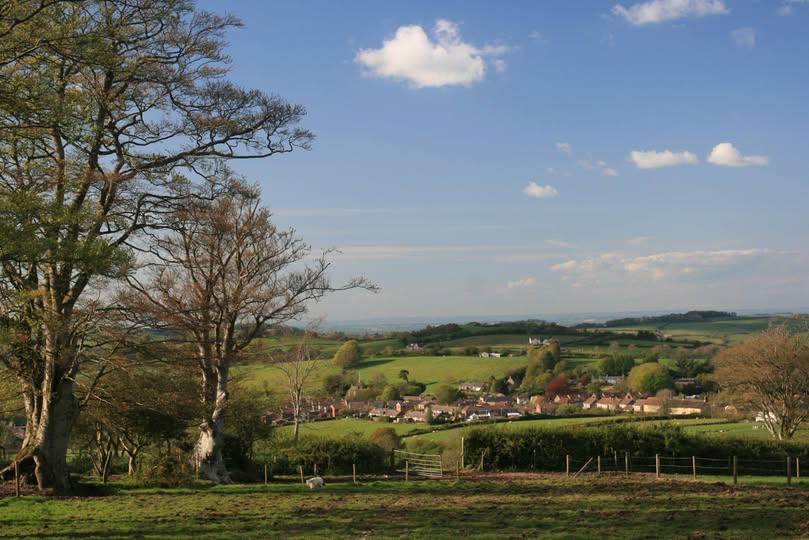
Lush Places from Bluebell Hill

Boot is the main character in Scoop by Evelyn Waugh, which was published in 1938. It’s dated now and very politically incorrect but I loved the juxtaposition of a naïve, gentle writer in the cut-and-thrust world of horrid Fleet Street hacks out to make a name for themselves in a forgotten corner of the world.

I was redrafting my latest novel about Lush Places’s seaside sibling when the new village’s name – and book title – came to me during the early hours of the morning.

There is a line in one of Boot’s nature columns – ‘feather-footed through the plashy fen passes the questing vole’ – which has come to signify an affected style when it comes to nature writing.

I guess the the term plashy fen must have stuck with me. It’s become a bit of a personal joke and serves the purpose of making me check my prose style every now to make sure I’m not coming across as a complete jerk.

So that’s the story of how Plashy Fen got its name.

But the characters, well, they’re a different story…

The Light of Experience

Today would have been my father’s ninety-ninth birthday.

He died in 2016, not long after he was ninety-one. It was a year my family won’t forget. We lost three close members in almost as many months.

It’s a sombre, sobering experience when that kind of thing happens. Makes you count your blessings for happier times and live for the day rather than dwelling in the past or worrying about the future.

My dad was a second generation tenant farmer from south Somerset, the middle of three sons. He was quiet, wiry and strong. He worked so hard it did his back in. He had an unbreakable connection to and affinity with the landscape, which he passed on to me and my four older siblings through osmosis.

We didn’t have many acres but he knew those fields like a dressmaker knows fabric and thread. Our small herd of Friesian cattle all had names – that was my mother’s doing, naming them after Native American tribes, exotic flowers and women from I Claudius.

He bred poultry – the rare breed Plymouth Barred Rocks, Barnevelders and Welsummers. His calves fetched top price at Taunton Market and he could spot a good heifer from a mile away.

My father was a prolific trickster, doing that thing people do with their thumbs, pretending to have sliced off the tip of his nose and then putting it back on again. He’d frighten me with spiders and challenge primary school friends to punch their way out of a paper bag by putting them into an animal feed sack.

He never went abroad until he retired, yet he hankered constantly for adventure. My mother told me that Dad had wanted to emigrate to Tasmania before I was born, but he never did. Too busy on the farm and with his growing family, I suppose. His younger brother was a Ten Pound Pom and emigrated to Australia in the 1960s, where their uncle had lived since the 1920s.

In the 1970s, my father somehow got the romantic notion that he wanted to be a tenant farmer in Ireland. During this period, he was an avid reader of the Irish Farmer magazine and the cow stalls hummed to the sound of Radio Athlone. But Ireland didn’t want him.

I’d forgotten this but my father was into world music before it was a thing. He loved The Chieftains (naturally, they were Irish) and the Romanian pan pipe player Gheorghe Zamfir, who came to prominence in the mid-1970s for the haunting theme to The Light of Experience, a BBC religious programme.

Gheorghe Zamfir in a video that could have come straight from The Fast Show.

Years before, I remember being in the kitchen at home and asking nobody in particular who it was that was playing Tom Hark on the radio.

Without hesitation, my father replied: ‘Elias and his Zig-Zag Jive Flutes.’

He was great at baking cakes. And his grandchildren will tell you that his egg and chips were the best we’ve ever tasted.

His shoes were the shiniest I’ve ever seen – ‘you can tell a lot from people’s shoes‘ – and he always wore a German belt that my grandfather had brought home from the First World War.

He loved the comedian Dave Allen (Irish again), boxing and Joan Bakewell.

Happy birthday, Dad.