It’s a grey day in February and I haven’t blogged for weeks.
Sorry.
Up on Bluebell Hill, high winds have wreaked havoc with the beech trees. The bridleway is unpassable, even for a high-jumping horse.
The forest floor is littered with the bones of old beeches, like a dinosaur graveyard.
It’s cold and drizzly today. On days like these, you can understand why people go away for months at a time to get some sunshine and to avoid being saddled with seasonal affective disorder, the acronym of which – SAD – couldn’t be more accurate.
Every now and then, though, the sun peeps through and, recently, we’ve had some cracking blue skies, which, despite the nonsense going on in the world at the moment, give one hope for the future.
Not much of a blue sky in this picture, but the combination of the frost in the fields and the outline of a majestic tree in the distance, naked against the winter sun, was an unexpected tonic.
It’s been a busy old few weeks – nay months – in the Grigg household.
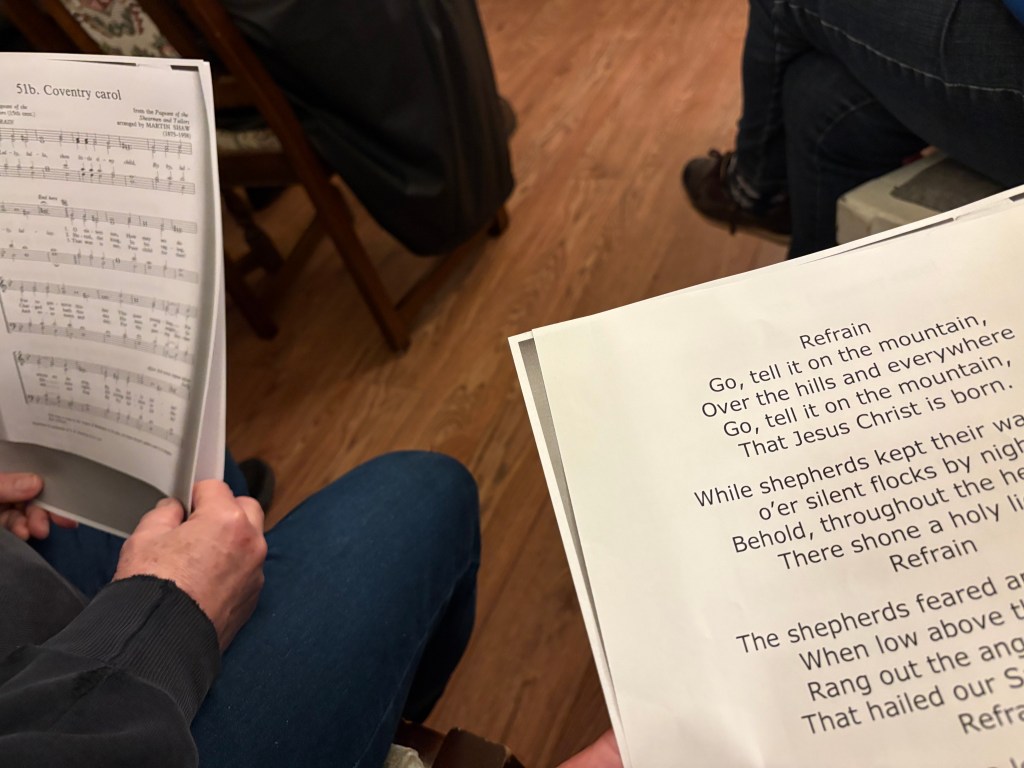
Alongside freelance work, there’s been a weekend away in London with the granddaughters for The Lion King, an overnight stay in Bournemouth to see The Human League with my flatmate from forty-three years ago, a school nativity play, the village carol service and putting on an archive film show to a packed audience in Bridport.
And that was just in the past week.
I’m not sure where the time goes but the year’s gone by so fast, I had a devil of a job keeping up with it.
The Christmas cards, bar a few, are nearly all delivered, presents bought and wrapped and a couple of days have been set aside over the weekend to prepare for Christmas next week and the big day that is Boxing Day when the hordes descend on our little house.
A New Year’s Eve playlist needs to be compiled and fine tuned for the party in the community pub, where, at just before midnight on 31 December, we all go out in the village square and sing Auld Lang Syne, and the traffic has to stop, whether it likes it or not.
A manuscript of mine has been shortlisted for The Eyelands Book Awards, which is very exciting and still is, even if I don’t win the competition. The unpublished novel – a cosy crime set on a Greek island (a kind of Bridget Jones-meets-Death In Paradise-meets-Mamma Mia!) had already been shortlisted in two other prestigious writing contests this year so I’m crossing my fingers, toes and eyes for this one.
I’ll be pursuing my search for a literary agent with renewed vigour in the new year, as well as working on the sequel, with a writing buddy from Australia who I ‘met’ on an online crime writing course run by Curtis Brown Creative.
Last year, we exhanged 5,000 words a week for critiquing, which was helpful in giving us the push we both needed to get our novels finished.
If you’re a budding writer and looking for impetus, I’d recommend the CBC courses wholeheartedly. Seven years ago, I signed up for one and I’m still in touch with group members, many of whom are now published writers. The support and encouragement we give each other is brilliant.
I’m not much of a one for new year’s resolutions but I’m endeavouring to get on with things, ticking off my copious to-do lists and living life to the full.
Blogging might take more of a back seat than usual, and how I use this website in the future is still up for debate, but you can find my column each week in The People’s Friend, the world’s longest-running magazine for women.
So Merry Christmas to you and yours and here’s to a peaceful, healthy and happy 2025.
You’ll have to wait a little while to read it, but I’ve worked out that’s about 300,000 words in the last decade.
Cripes!
I could have written a J R R Tolkien-like epic at that rate, if only I’d put 600-700 words down towards it every week for ten years.
Still, the gig at The People’s Friend – the world’s longest-running women’s weekly magazine – is a joy, especially as it came to me without any pitching on my part.
Back in 2006, I started studying for a Bachelor of Arts degree in humanities with The Open University, alongside working full time.
I took two creative writing modules as part of my studies and, in 2011 I was awarded a first class honours degree. It was a wonderful experience, and I’ll never forget the graduation ceremony, surrounded by family and friends and fellow graduates.
As part of the first creative writing module, I started a blog called The World From My Window in which I charted everyday life.
I was put on to blogging by my old flatmade, Gail, who runs the fashion and book blog for over-50s, Is This Mutton?
It was a good move – the blog got me and my writing out there and attracted the attention of The People’s Friend, whose editorial team just happened to be looking for a weekly columnist.
I am forever pinching myself for my good fortune. And the day I received my official contract through the post from D C Thomson (publishers of The Beano, no less) felt like winning the Lottery.
The moral of this story is that if you love doing something, just do it. Who knows where it might lead?
I came late to the Lessons in Chemistry party but I loved everything about this novel.
An inspiring, hopeful narrative with meaning and feminist optimism, laugh out loud moments and the most wonderful characters to root for in 1960s America. I borrowed the book from a friend and had only a short time in which to read it. But it didn’t matter, I was hooked from start to finish.
A brilliantly clever debut, easy to read and very memorable.
What an extraordinary novel! I found it to be beautifully written, very witty and unusual in its second person telling (such a difficult perspective to pull off, but Alice Franklin does it superbly) of the story of a young child growing up in a suburban household in south east England. It seemed very American to me at times, in its use of language and experimentation, which gave gravitas to this coming-of-age story about a little girl who feels different. It was incredibly moving and warm, I was hooked.
As I fell into the story, I wondered where on earth it was going to go, so when I reached the part of ‘Little Alien’s’obsession for and pursuit of the truth behind the Voynich manuscript, a 15th century codex of uknown origin (which I’d never heard of), it took me into an entirely unexpected realm altogether.
Tender, insightful and funny – and hugely original.
Thank you to NetGalley and the publishers for an advance review copy of this novel. It’s one I won’t forget in a hurry.
When a baby is found by the sea in Donegal, on the north west coast of Ireland, the child is taken in by a young fisherman and his wife. They adopt the boy, call him Brendan and bring him up alongside their small son, Declan. The story follows Brendan and Declan’s stories and that of their parents, set against the brooding backdrop of a landscape almost cut off from the rest of the world. As the children grow up, what emerges is one of those quiet and satisfying tales of family life – with joy and heartbreak, conflicts and misunderstandings – told from the various viewpoints of the characters through an eavesdropping voice of a villager acting as a narrator.
An astonishing debut, haunting and gentle, with well-drawn characters and atmosphere to make the reader feel part of the community in which Brenda and Declan are growing up,
Thank you NetGalley and the publishers for an advance reader copy of this novel.
The novel starts off in 1957 with Sonny, a young man from Shetland, working on a whaling ship in the South Atlantic. We move on to the present day to his son, Jack, now in his early 60s, and flit back and forwards to Jack’s life now and his formative years with his father, Sonny, and mother, Kathleen, in the house on Shetland where he was brought up and still lives. Jack is obsessed with country music and the chapters are interspersed with his handwritten songs.
This is a quiet, thoughtful, beautifully written literary novel, where not much happens but with a haunting, evocative depth to it that is hard to explain or define but leaves the reader wistful and contemplative.
Thank you to NetGalley and the publisher for an advance reader copy of this novel.
Only Elizabeth Strout can write a slow-paced novel about the quiet minutiae of everyday life in a small town where nothing much happens (except everything does,) to such great effect. I had this book on my ‘to be read’ pile for a while, savouring just seeing it there and knowing the pleasure I would get from devouring it a month or so down the line. Her books don’t ever have much of a plot, but the depth of emotions and feelings she is able to convey by just a character’s look or nod of the head is astounding.
In Tell Me Everything, the familiar characters of Lucy Barton and an elderly Olive Kitteridge feature strongly in the cast, which is led by nice Bob Burgess, who comes to realise that he is in love with his dear friend, Lucy. This is a novel about family, relationships, friendships, misunderstandings, brutality and the things that might have been.
For me, nothing Strout writes will ever top the wonderful Olive Kitteridge, whiich is one of my favourite books. But Tell Me Everything comes very close. There is something about her measured, sometimes old fashioned style of writing which I absolutely adore.
Thank you NetGalley for the advance reader copy of this book.
Back in 2011, Lush Places was landed with the unwelcome addition of a mass of bright white street lights.
They appeared all around the village square and marched like War of the World aliens along the road to the primary school, and all without any public consultation.
Subsequent protests to the county council fell on deaf ears.
Our erstwhile leaders insisted the lights were necessary to illuminate new traffic calming measures, on which the village had been consulted although the new lights were never once mentioned, nor did they appear on the plans shown to residents.
We were all set to join forces, stop the traffic and have a game of football under the new floodlights, just to prove the point that they were brighter than anything the village had ever seen. And the hideous poles were more in keeping with an edge-of-town industrial estate than a pretty rural village where King Charles II once holed up for the night back in 1651 when he was on the run.
Despite numerous meetings, letters and the support of our local MP, we were given the brush off.
We put in blackout curtains to help us sleep at night and a shield was installed on the lamp outside my neighbour’s house to try to stop the glare piercing through their window.
Disquiet built up. I made a formal complaint to the council about how the lights had just appeared without anyone knowing it was going to happen.
The complaint was partially upheld, particularly the bit about lack of consultation. At the time, the council pledged to learn from its mistake and make sure the public was consulted on lighting schemes in the future.
But, anyway, it would not be unreasonable to assume that local residents likely to be affected by new street lights would at least be notified before installation, either by the council or the contractor.
It seems not.
These have recently appeared up the road.
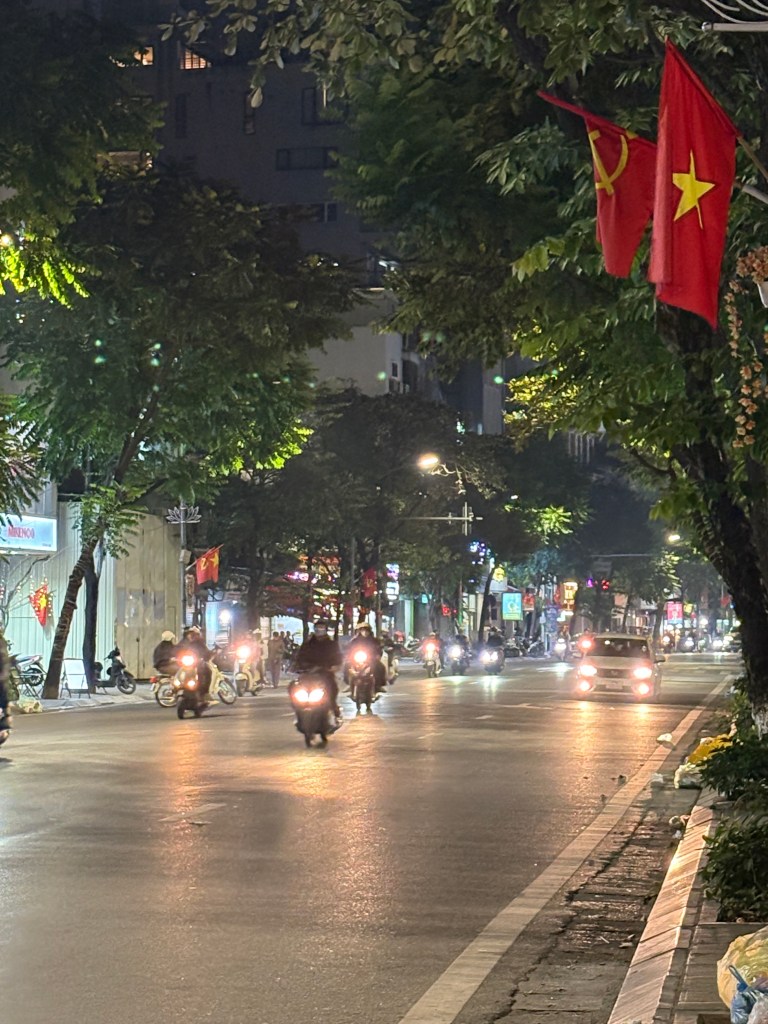
It’s difficult to photograph accurately, but the three lights really are that bright, shining into windows at night like static searchlights.
The good thing is that the new lanterns are energy saving, and they were fixed to existing poles, although in some places in Dorset, streetlights are turned off at night to reduce costs.
The official line is that the lanterns do ‘appear different as they are now a white light which is remarked upon by some’.
Remarked upon? Screamed about, more like.
But there is no mention of public consultation. However, there are ways of making people talk…