
There are Apple Days being advertised here in West Dorset and, of course, just over the border in Somerset.
The tradition dates to 21 October 21 1990 when the first Apple Day was held in the old Apple Market in London’s Covent Garden, bringing fruit back there for the first time in 17 years.
The idea was developed by Dorset-based charity Common Ground, as a way of celebrating our most versatile fruit.
It’s a scrumptious time of year and sends me back to my childhood days when we had an orchard on the farm in South Somerset.
Most of the trees had been planted by my grandfather for cider, although there was the odd one or suitable for eating.
In the Second World War, the farm was a bit of a magnet for American soldiers keen on sampling the amber nectar.
In later years, when Grampa stopped making his own, the apples were sent to Perry’s Cider, at nearby Dowlish Wake.
If you’re ever down this way, it’s definitely worth visiting Perry’s. It has a small museum, cider tastings, a great cafe and a farm shop.
There is an orchard in my novel, Plashy Fen, next to a field where the three Symes brothers live in separate caravans. Dave goes rabbiting with his ferrets up on Bluebell Hill, Jacko is silent and bedbound and looked after by village heroine, Lindy Vickery. The eldest of the three, Tom Symes, is the nurturer of the apples.
Back in the Eighties, their father had resisted all attempts to grub out the orchard like the other farmers had done. People had laughed at their father then, calling him old-fashioned and lazy. Old-fashioned, maybe, but you could never call Adam Symes lazy. Just respectful of the old ways. And now people, new people, were emulating that approach to farming as if no one had ever thought of it before. Bloody blow-ins.
I’m grateful for the help of local cidermaker Nick Poole, who wrote a book with Liz Copas called The Lost Orchards: Rediscovering the Forgotten Cider Apple of Dorset.
Nick – who I’ve known for years – was so generous in sharing his knowledge and love of apples local to the West Dorset area. And he allowed me to use his own words – verbatim – to describe the apples that he – and Tom- love the most.
Here’s a passage from the novel, with Nick’s words incorporated:
One of the family’s favourites was the Symes Seedling, which Great-Grandpa had invented. Like a Tom Putt for cider making but closer to a King’s Favourite in shape, its skin a yellowish green with red streaks most dense around the stem.
Best of all, though, was Golden Ball. Tom always felt a bit bad for thinking that, as his loyalty should have been with the Symes Seedling. But there you were, there was no accounting for taste. Golden Ball was the stuff of legend, standing head and shoulders above all other apples known to mankind. It was a properly handsome apple, changing through the season from dull greens to red flush, finally arriving in all its glory as a true golden orb with a delicate brown latticing by late October. It made excellent cider.
I’ve just picked up some cooking apples from the top of my village. Not scrumped, you understand, but to make the most of a box marked ‘FREE’.
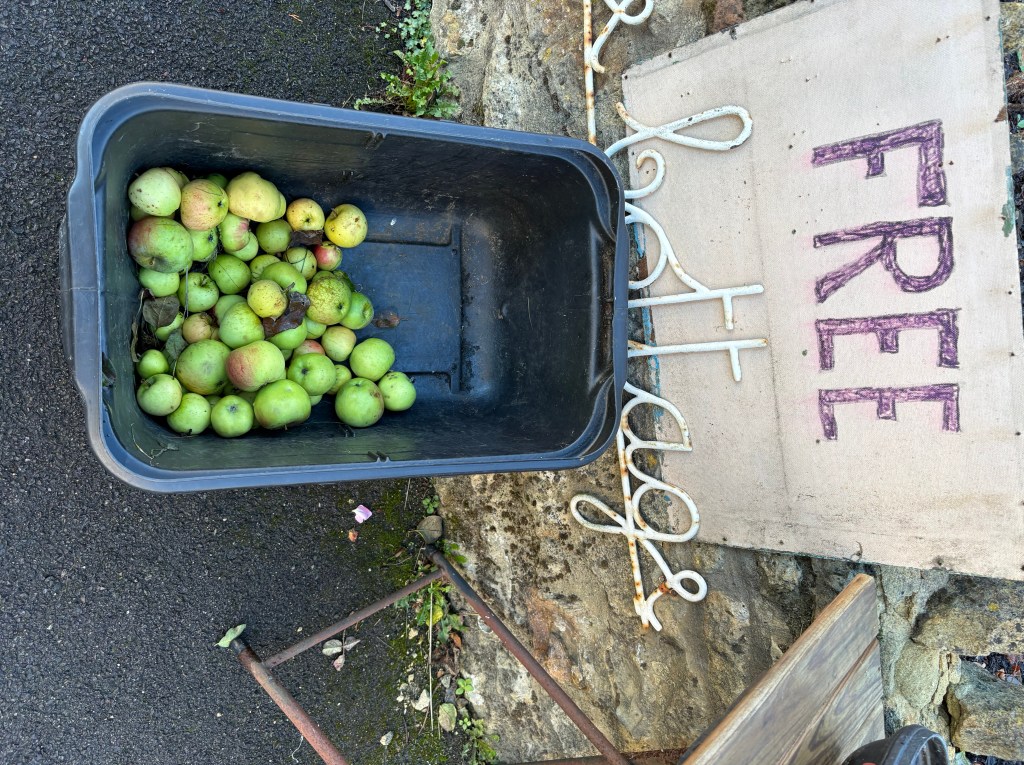
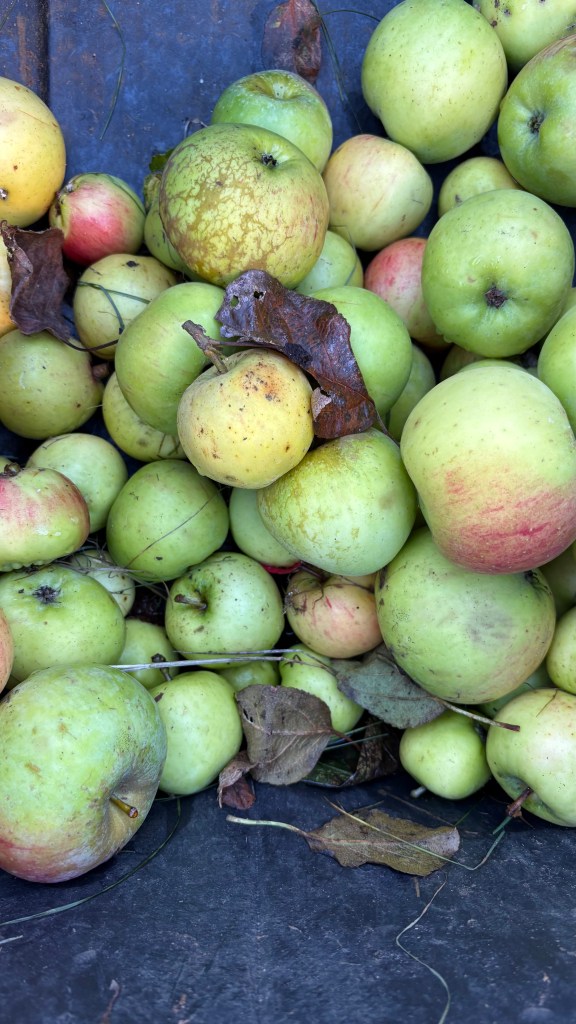
Time to make apple crumble, I think.
Have a great weekend.
Love, Maddie x


