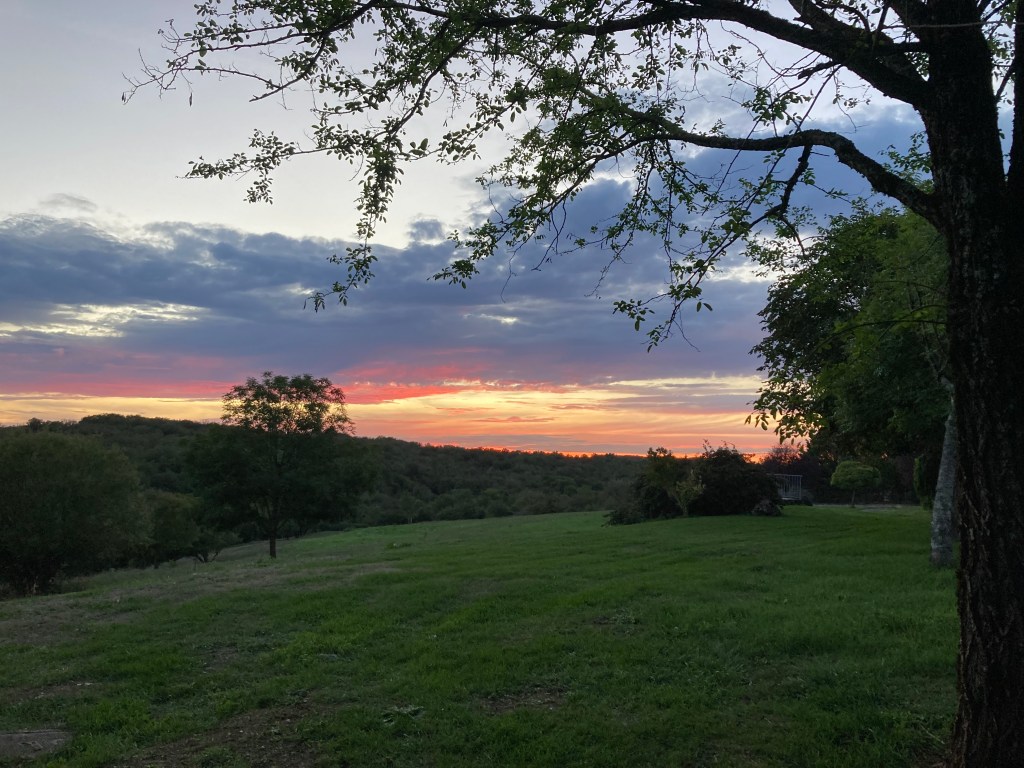
It’s the autumn equinox, the time of year that looks ahead to the dark days and nights of winter, and glances back, just a little bit wistfully, to the glory days of June, July and August.
Here in the northern hemisphere, it’s the last day of summer – autumn has finally arrived. For friends and family in the southern hemisphere, it’s reversed, so it’s the first day of spring.
Confusingly though, for meteorologists, autumn begins on 1 September, making the autumn months September, October and November.
On the equinox, day and night are roughly 12 hours long.
In the agricultural calendar, we have to wait until Michaelmas – 29 September – for the quarter day.
Years ago, a traditional meal for Michaelmas was goose, raised in the stubble fields. If you were a tenant farmer, you might have given the goose to your landlord. Which is a shame, because you, being poor, probably needed it more than them, being rich and powerful.
Whatever, whenever, the equinox marks that turning point of the seasons.
School has started, university freshers’ weeks are upon us and it’s a time of change.
Short sleeves and flimsy linen dresses are put back in the cupboard, but within easy reach should we get an Indian Summer in October, and the DM Chelsea boots are given a spit and polish and you thank goodness that years ago you bought the ones with zips now that you’re finding it ever harder to pull them onto your feet.
It’s a time of discovery, when you find you actually do have more coats and jackets than there are days of the week and, in actual fact, they’re not bad, not bad at all.
It’s a time to top up the wood pile, order the heating oil and start knitting again.
Cosy nights in, stews that stick to your ribs and cocoa instead of coffee.
Watching some brilliant drama – old favourites like the latest series of Slow Horses, due any moment now, and the finale of Stranger Things, where the child actors are now grown up but the story is still (I hope) as gripping, and then new shows too, which will unfold as the months unfurl.
Curling up with a good book without feeling guilty about it, and leaving the garden a bit overgrown for the wildlife, ready to attack it properly at a much later date.
It will be my last review for the HNS because I have other irons in the fire, which I must pull out at some time to check if they’ve reached the correct temperature.
I’m still a reviewer for NetGalley, and I’ve just finished this:
(Due to be published by Harper Collins 25 September 2025)
Set just after the First World War, The Naked Light tells a a dark story of life in a small rural village where the inhabitants feel protected by the Face, a simple and ancient chalk image on a hillside, which acts as a kind of amulet against evil.
We follow the fortunes of beautiful spinster, Florence, her precocious and unsettling niece, Phoebe, and a female artist called Kit, who is haunted by the disfigured soldiers from her war work and moves into an old cottage which used to be the home of the Bone family, who were custodians of the Face.
The Naked Light is a slow burner, but a fascinating story of womanly love, darkly Gothic in places and peppered with a heavy dash of country folklore, which serves as allegorical device bringing home the horror of war and its effects on a small community.
Bridget Collins is imaginative and writes beautifully. This is a novel that will stay with me for some time but I struggled to like or understand some of the main characters, hence my giving it three stars.
Films worth watching (or not)
I’ve watched three films recently, only one of which I actually enjoyed (in the main).
As you’d expect, Happy Gilmore 2 is the sequel to Happy Gilmore, a sports comedy film from 1996 which Mr Grigg particularly enjoyed because it involved lots of whacking. And I quite liked the original because of the underdog-conquering-stuffy-establishment-vibe (think Eddie the Eagle and Dream Horse, two excellent examples of the genre).
Happy Gilmore 2 sees Adam Sandler reprise his role but now as a winner down on his luck. He’s a widower, an alcoholic and hasn’t played golf for years but is forced into it because his talented daughter needs to go to dance school.
I’m not keen on anything with Sandler in it and this film relies heavily on in-jokes and characters from the first movie. If, like me, you’ve forgotten those, then you’ll probably sit in front of the screen po-faced and reaching for the fast-forward button.
I can’t recommend the film but I was fascinated that Sandler recruited his wife and two daughters for peripheral roles. Keeping it in the family led me down a long internet rabbit hole which was far more enjoyable than the film.
The fourth film in the slapstick crime franchise, in which the late Leslie Nielsen made the role of cop Frank Drebin his own back in the 1980s (I just loved Police Squad!, the American comedy crime series on which the films were based), sees Liam Neeson playing Frank’s son, Frank Drebin Jnr.
If you like corny jokes, seeing Neeson stumbling around in a ridiculous setting and a plot as far-fetched as the way in which politics is going all over the world, you’ll love this. The only similarity between the two actors is their names.
I’ve never been able to take Neeson seriously since I saw him as Zeus in the dreadful 2010 remake ofClash of the Titans, where he utters the immortal line: ‘Release the Kraken’ to unleash the monster onto poor, chained-up Andromeda.
This line has been used many times during lock-ins at the Lush Places pub, although I hasten to add that lock-ins there, now it’s a community pub, are a thing of the past.
Mind you, these days, Neeson, who was in the Oscar-winning Schindler’s List (1993), doesn’t seem to take himself too seriously either, playing recent roles with as much depth as a half-inch ruler.
But I did like him in the action thriller In The Land of Saints and Sinners (2023), set in a very beautiful and stark Donegal. He plays a quiet contract killer in this surprisingly moving film.
However, I digress. The Naked Gun is terrible, apart from having ex-Baywatch beauty Pamela Anderson in the same sort of role that Priscilla Presley (who makes a cameo appearance in the latest film) played in the original.
Pam is now 58 and still a stunner, embracing the ageing process both boldly and beautifully, a shining, make-up free beacon for older women rejecting the relentless barrage of turning back time.
So I’ll let them both off for having a laugh, even if the audience is not splitting its collective sides.
This takes a while to get going but it’s a lovely film, starring Naomi Watts as Iris, a writer coming to terms with the death of her friend and mentor, Walter, a louche author played by Bill Murray.
Set in New York, Iris finds it hard to grieve for Walter and is bottling-up her emotions. All around her, the women that were close to him have their own agendas when it comes to mourning, and seem to be expressing themselves much better than she can.
Iris has been tasked, along with Walter’s daughter, with putting together a book of his letters, but she’s struggling.
It’s not just writer’s block, but something that goes deeper.
Things begin to change when she finds herself having to look after Walter’s dog, Apollo, a Great Dane ‘the size of a pony’, which dominates her small apartment and her life.
The performances, sentiments and storyline, are lovely, particularly Bing as the massive, mournful dog.
I’ve never had a hankering for a Great Dane but I do now.
A long film (120 minutes), but definitely worth a watch. Gentle, heartwarming and touching on universal themes in a understated and layered way.
I woke up this morning with heartburn and a television theme tune whirring around in my head.
It was for a British television sitcom, and I was convinced it was from Please Sir!, in which a young teacher (played by John Alderton) attempts to instruct his unruly class of 16-year-old pupils.
It ran on ITV between 1968 and 1972 and was a staple feature in my house as I was growing up, which puts paid to the family legend that I was never allowed to watch anything but the BBC because my late mother deemed the ‘other channel’ well, ‘a bit common’.
The supporting cast included Joan Sanderson as the headmistress (she later took the role of Mrs Richards, a deaf and domineering guest in an episode of Fawlty Towers, and made it unforgettably her own) and Deryck Guyler as Potter the janitor.
This memory sent me down a rabbit hole where I discovered this:
I don’t remember it. Fortunately.
Then I played the theme tune to Please Sir! and realised the tune in my head was nothing of the sort.
But I did find this trailer for the film version from 1971. I wonder if it’s still available to watch? It’s very much like looking through a glass darkly at my own comprehensive school education which I started the year afterwards.
Anyway, I sang the theme tune that was in my head to Mr Grigg. He looked at me as if I were an escaped badger. He was none the wiser, which is probably because of the way I sang it.
And then it came to me. The theme tune was for this:
Another British sitcom made by London Weekend Television from 1969 – 1970.
They don’t make programmes like this any more. Which is probably just as well.
I’d hoped to bring you several book reviews this month, including one for the new novel by Bridget Collins, The Naked Light, which is out later in September.
I wasn’t so keen on her first adult novel, The Binding (2018) but I absolutely lovedThe Silence Factory, which came out in 2024. You can read my review of that book on Goodreads here.
I’m fully immersed in this retelling of the Jason and the Argonauts and then the Medea story, but I can’t tell you anything until the HNS publishes my review.
Anyway, instead of book reviews this month, I bring you some of my observations on the latest film releases. Before I get into that, can I just say how excited I am by the Christopher Nolan epic coming to a big screen near you and me next year.
The Odyssey is such a classic story in Greek mythology. The 2026 version (to be fair, there aren’t many others) features a star-studded cast, led by Matt Damon as the barrel-chested hero who encounters obstacle after obstacle – ferocious as well as seductive – in his ten-year quest to get back from a decade fighting in Troy to rule Ithaka.
Meanwhile, at home on the island, Odysseus’s patient wife Penelope (Anne Hathaway?) is battling off opportunist suitors by the Greek urn-load, spinning them a procrastinating yarn to avoid being hitched up to any of the blighters.
Filming only finished last month, and there’s many a slip between cup and lip, but I’m looking forward to next summer when the movie is due to be released.
I hope it captures some of the lyrical beauty of Homer’s epic poem and isn’t just a nonsense fest in the style of Gladiator II but more like the magic of the 1963 Jason and The Argonauts film and the magnificent stop-motion animation visual effects by Ray Harryhausen.
That film from my childhood, along with Enid Blyton’s children’s book Tales of Long Ago, got me into Greek mythology in the first place, which explains why I was so ill prepared when I attempted a masters degree in classics and ancient history fifteen years ago.
Enough of this rambling. Here are some films I’ve seen recently.
Starring Brad Pitt as a grizzled and handsome racing driver Sonny Hayes who’s come back to the Formula 1 circuit after a 30- year absence, this sports drama is perfect for those who love the thrills and spills of the race track.
I’m not a fan of car racing, and the plot is pretty pedestrian but the 155-minutes (insert Scream emoji here) passed almost as quickly as Pitt does on screen when he drives to win rather than to aid his young team mate.
Javier Bardem looks great in a suit and nothing like the terrifyingly ugly character in the Coen brothers’ No Country For Old Men(2007). His potrayal of a psychopath armed with a captive bolt pistol has forever haunted my dreams but in F1 he positively glows.
This is a bit of a boys’ movie, although Kerry Condon‘s technical director is a big shout-out to girl power, even though (unsurprisingly) she falls for the charismatic Sonny. I mean, who wouldn’t?
Like the book by Richard Osman, this film has divided the critics, some lauding it, others calling it a disaster.
I read the novel and, okay it’s not high literature, but it’s well written, witty and driven by a dream team of characters.
The actors playing that group of old sleuths in a luxury retirement home fit their roles perfectly, although Pierce Brosnan‘s character of ex-trade union leader Ron might have been better played by Ray Winstone.
Still, this ensemble cast, including Helen Mirren, Celia Imrie and Ben Kingsley, do great justice to the source material and conspire to create a gentle, funny and typically British whodunnit which is easy on the eyes and an agreeable way to spend 118 minutes (but why are today’s films so long?)
Directed by Chris Colombus with screenplay by Katy Brand and Suzanne Heathcote, The Thursday Murder Club is destined to go down well in village halls up and down the UK.
As a Jurassic Park fan who goes weak at the knees on hearing the John Williams’ score, I confess to thinking this latest film might end up in the naff pile.
The last few films in the franchise have been pretty dire. To be honest, I wasn’t expecting much.
I couldn’t have been more wrong.
The dinosaur theme park setting has been ditched and a completely new – although familiar in many ways – story is unearthed.
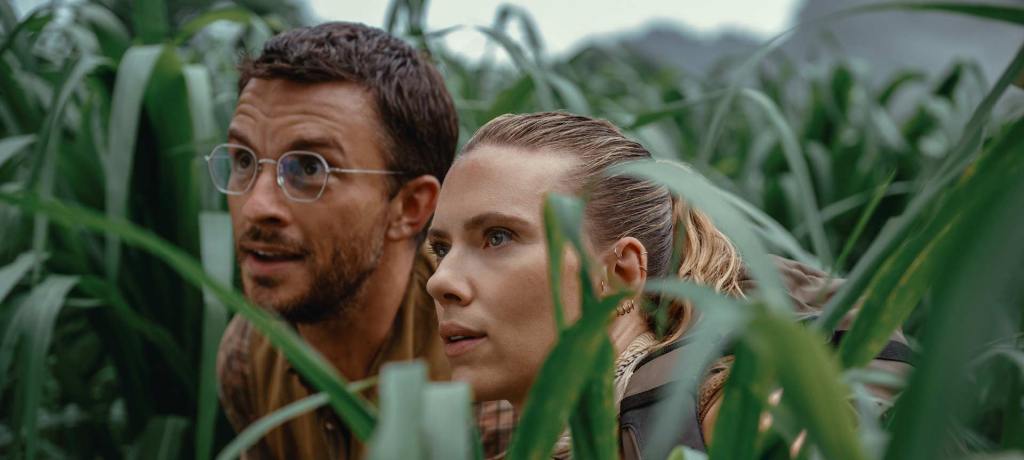
Scarlett Johansson leads a disparate and desperate group to an equatorial island in search of mutant dinosaur samples, which a grasping pharmaceutical company wants to use as a life-saving treatment for heart disease.
She’s paired with a geeky paleontologist played by Jonathan Bailey, who’s come a long way since playing the rookie reporter in Broadchurch. Add to the mix an imposing and steady sea captain played by Mahershala Ali, a snivelling villain played by Rupert Friend and a family rescued from certain death, led by Manuel García-Rulfo, and you have the recipe for some solid family entertainment.
The monsters are terrifyingly hideous, the scrapes the humans get into are nail-biting and if Jaws ever made you think about twice about getting into a boat, then the creatures patrolling these waters will put you off sailing for life.
Complete hokum but surpisingly gripping and entertaining. Recommended.
Another solid novel by Steve Cavanagh in the Eddie Flynn series.
Even if you’ve not delved into Eddie’s world before, you’re in for a treat with this thriller.
Lawyer Eddie Flynn is hired to defend Ellie, a social media celebrity whose perfect world is turned upside down when she is accused of the murder of her husband and her best friend. The two victims were having an affair, which Ellie had revealed inadvertently in real time when she was doing a live stream at her perfect aparment in New York.
Eddie is pitted against the cunning of charismatic sociopath, Logan, a chilling killer, while, at the same, time protecting his own daughter, ex-wife and her husband when they are pulled into Logan’s complicated web.
This is a bingeworthy novel, which could easily be read in one sitting.
As soon as it hooks you in (which is very quickly), Two Kinds of Stranger will have you turning the pages to reach the climactic conclusion.
Recommended for lovers of taut, high-speed thrillers and seat-of-the-pants courtroom dramas.
Thank you NetGalley and to the publishers for an advance review copy of this novel.
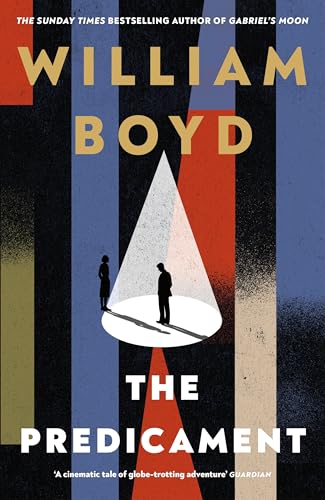
I have loved William Boyd’s previous novels but this was my first foray into Gabriel Dax territory.
Boyd turns the spy novel on its head – a bit of a pastiche, written with verve and wit and a surprising lead character who seems to bumble through things and situations – including romance – and comes up smelling of roses.
It’s the early 1960s and travel writer Dax is called upon by MI6 to carry out several top secret assignments, the last of which involves President John F Kennedy. It’s comic but Boyd’s gift for writing makes this a very readable novel and not at all clunky. I did feel a bit overwhelmed by plot and some of the villains and for that reason I’m giving it three stars.
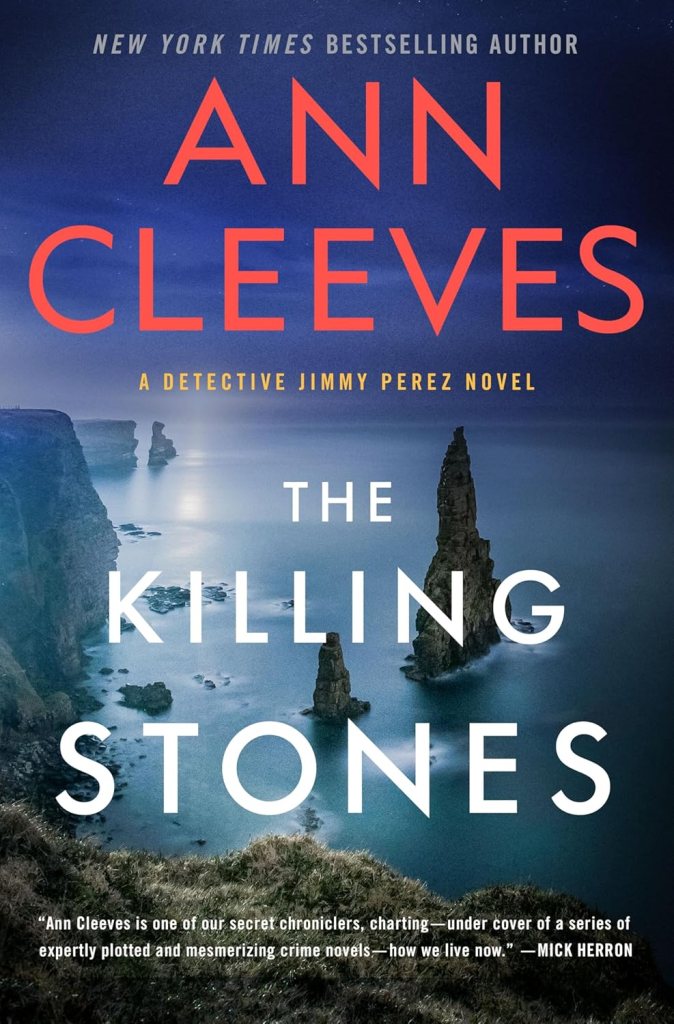
Jimmy Perez, the detective protaganist of the ‘Shetland’ series of novels, returns for another quiet thriller. But this time, he’s in Orkney, where he is happily settled down with Willow and their young son, James.
When his best friend from childhood, is brutally murdered on an ancient archaeological site, Jimmy and Willow are drawn into a tangled web of murder and mystery in a small, island community, where everyone knows everyone else’s business, newcomers never quite fit in and where legend and folklore run deep.
Archie’s death is followed by two more gruesome killings, both at other significant sites on the islands. Can Jimmy and Willow solve the crimes and keep the community safe?
This is a solid, reliable and thoughtful thriller where, of course, everything is not quite so straightforward as it seems initially. A list of suspects reveals itself to Jimmy and Willow, together with some plausible motives. I had my suspicions about the killer’s true identity quite early on but not the reasons for their actions.
This was my first Ann Cleeves’ novel, having only seen the Shetland television series previously. Perez was nothing at all like Douglas Henshall who plays him on screen, but I still had the image of the actor in my head when I visualised the detective.
For me, there was too much telling as opposed to showing and that annoying thing when you as the reader know that the protagonist has been told something important because the author tells you that but the ‘what’ is not revealed to you until the end.
A map of the Orkney islands at the beginning of the novel would be useful, especially in a print version.
Thank you to NetGalley and the publishers for advance review copies of these novels.
NetGalley is an online platform for booksellers, librarians, educators, and media professionals to discover and recommend books. Publishers and authors offer free digital books and audiobooks to the NetGalley community of book advocates and industry professionals.





 Maddie Grigg