We have ways of making you talk…

Back in 2011, Lush Places was landed with the unwelcome addition of a mass of bright white street lights.

They appeared all around the village square and marched like War of the World aliens along the road to the primary school, and all without any public consultation.

Subsequent protests to the county council fell on deaf ears.

Our erstwhile leaders insisted the lights were necessary to illuminate new traffic calming measures, on which the village had been consulted although the new lights were never once mentioned, nor did they appear on the plans shown to residents.

Understandably, there was uproar and outrage.

I blogged about it at the time. Here’s the link.

We were all set to join forces, stop the traffic and have a game of football under the new floodlights, just to prove the point that they were brighter than anything the village had ever seen. And the hideous poles were more in keeping with an edge-of-town industrial estate than a pretty rural village where King Charles II once holed up for the night back in 1651 when he was on the run.

Despite numerous meetings, letters and the support of our local MP, we were given the brush off.

We put in blackout curtains to help us sleep at night and a shield was installed on the lamp outside my neighbour’s house to try to stop the glare piercing through their window.

Disquiet built up. I made a formal complaint to the council about how the lights had just appeared without anyone knowing it was going to happen.

The complaint was partially upheld, particularly the bit about lack of consultation. At the time, the council pledged to learn from its mistake and make sure the public was consulted on lighting schemes in the future.

New lighting schemes are being installed across the county as part of a private finance initiative and, according to Dorset Council’s website, the contractor is responsible for the ‘customer interface’. Whether this means public consultation, I have no idea. My proficiency in local authority jargon has lapsed in recent years.

But, anyway, it would not be unreasonable to assume that local residents likely to be affected by new street lights would at least be notified before installation, either by the council or the contractor.

It seems not.

These have recently appeared up the road.
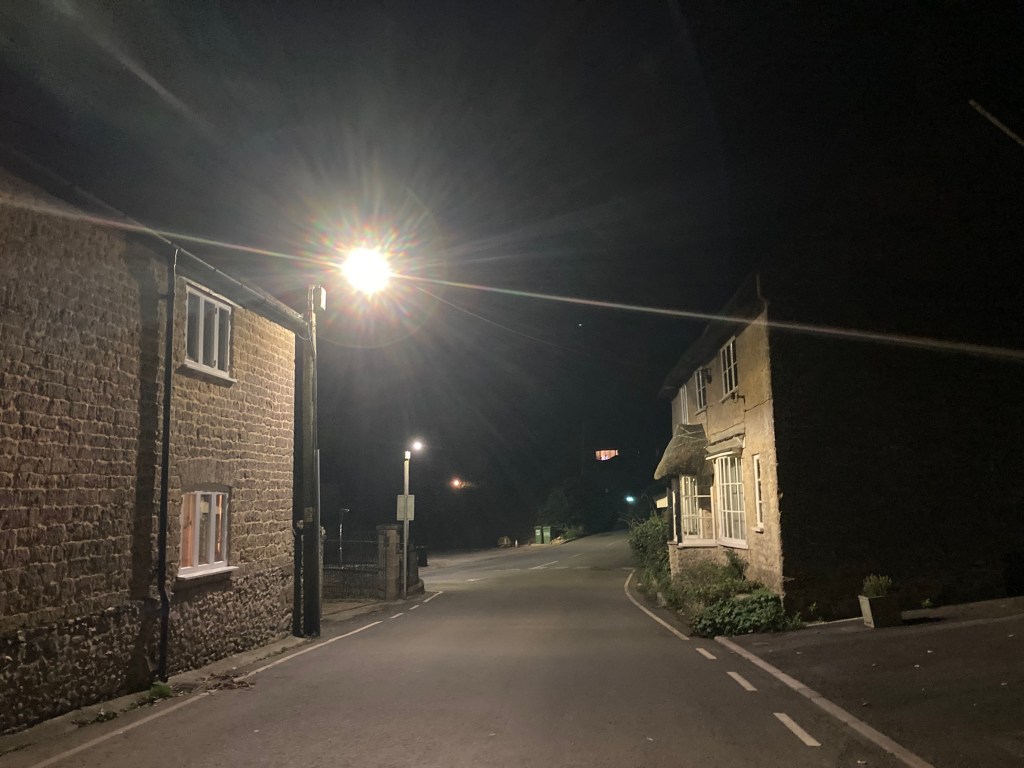
It’s difficult to photograph accurately, but the three lights really are that bright, shining into windows at night like static searchlights.

The good thing is that the new lanterns are energy saving, and they were fixed to existing poles, although in some places in Dorset, streetlights are turned off at night to reduce costs.

The official line is that the lanterns do ‘appear different as they are now a white light which is remarked upon by some’.

Remarked upon? Screamed about, more like.

But there is no mention of public consultation. However, there are ways of making people talk…

Raise a song of harvest home

Tractors are hauling high-sided trailers full of maize through the village.

It’s the day after the annual village Harvest Supper which this year was held, appropriately on National Farmers’ Day. Until last night, I had never heard of it.

It was a question in a quiz about Dorset and countryside miscellany. Our table did rather well, despite not knowing the height of the Cerne Giant (180 feet), Britain’s tallest and best-known chalk hill figure, or the number of one of the loveliest routes in the country – the coast road between Bridport and Beaminster. (It’s the B3157.)

We did know the name of three assorted cauliflowers (an educated guess), where Dorset’s Chesil Beach starts and ends (West Bay to Portland) and where Frankenstein author Mary Shelley is buried (Bournemouth).

But nobody in the whole room knew the date of National Farmers’ Day, even the handful of working and retired farmers who turned out for the feast in our village hall.

Our table guessed Lady Day (25 March), when, traditionally, farm tenancies are renewed and rents are due, but we also thought it could have been Michaelmas (29 September), as that quarter day falls in the harvest season.

It was neither.

It was 12 October. Apparently.

When I got home I looked it up, suspecting National Farmers’ Day might be an American invention.

According to Wikipedia, it’s marked on different dates around the world. The article states goes on to say that it’s held on 12 October in the USA. But there was no mention of the UK at all.

That’s probably because every day is farmers’ day – they’re always working.

Anyway, it’s too late for a steward’s inquiry and we did have a wonderful evening, with fabulous food, served with smiles and grace by Mrs Bancroft and her hardworking team.

I was asked by The Parson’s Daughter to sing with her the opening note to Come Ye Thankful People, Come because our tuneful vicar was away.

We won a bottle of wine on the raffle, were entertained by our village Gallery Quire, resplendent in Thomas Hardy-era costumes, and bought a bag of squashes and Scotch Bonnet chilli peppers, which look beautiful and quirky but will no doubt blow our socks off.

Hats off to all those involved in putting on the Harvest Supper. Long may this lovely tradition continue.

The Geate A-Vallen To

With Covid or whatever it was having only just flown the nest (it took nearly a whole month), we’re now back in Dorset to lovely weather (I jest) and a warm welcome (I do not jest).

This morning, I walked out along the lane with Ruby and Edgar to a gate which reminded me of a poem by the Dorset dialect poet William Barnes (1801-1886).

The Geate A-Vallen To was apparently Barnes’ last dialect poem and it’s one I love because it was a favourite of older family members who, although from rural south Somerset, could do a pretty good rendition of the Dorset dialect.

There’s a YouTube link at the end of this blog to a chap reading the poem. His voice is far too posh but you get the gist. But I recommend trying it out yourself first by reading it aloud:

The Geate A-Vallen To

In the zunsheen of our zummers
Wi’ the hay time now a-come,
How busy wer we out a-vield
Wi’ vew a-left at hwome,
When waggons rumbled out ov yard
Red wheeled, wi’ body blue,
And back behind ‘em loudly slamm’d
The geate a’vallen to.

Drough daysheen ov how many years
The geate ha’ now a-swung
Behind the veet o’ vull-grown men
And vootsteps of the young.
Drough years o’ days it swung to us
Behind each little shoe,
As we tripped lightly on avore
The geate a-vallen to.

In evenen time o’ starry night
How mother zot at hwome,
And kept her bleazen vier bright
Till father should ha’ come,
An’ how she quicken’d up and smiled
An’ stirred her vier anew,
To hear the trampen ho’ses’ steps
An’ geate a-vallen to.

There’s moon-sheen now in nights o’ fall
When leaves be brown vrom green,
When, to the slammen o’ the geate,
Our Jenny’s ears be keen,
When the wold dog do wag his tail,
An’ Jean could tell to who,
As he do come in drough the geate,
The geate a-vallen to.

An’ oft do come a saddened hour
When there must goo away
One well-beloved to our heart’s core,
Vor long, perhaps vor aye:
An’ oh! it is a touchen thing
The loven heart must rue,
To hear behind his last farewell
The geate a-vallen to.

Good morning starshine

I’m not sure what it was that woke me up.

It was before sunrise and still dark.

But when I looked out the window to the east, there was a stirring sight I hadn’t seen for months.

The constallation of Orion the Hunter, with his distinctive starry belt and dagger, the ghost of the shimmering summer dawn.

According to the website EarthSky, that apt description comes from a poem by Sophia C Prentice which was published in Popular Astronomy magazine in 1924, and is reproduced below. The poem celebrates the mighty hunter, whose distinctive shape figures prominently in the winter night sky of the northern hemisphere.

Orion is one of the easiest constellations to spot, a reassuring presence on crisp and cold nights in winter, yet a surprise summer visitor for those, like me (who could sleep through a herd of elephants traipsing through the bedroom), who are not usually awake before the sunrise.

The sight of Orion right outside my window reminded me of an encounter I had a few years ago. I’d made contact with an astronomer during what turned out to be an unsuccessful campaign to remove a plethora of dazzingly bright street lights in my village, which had been imposed suddenly by the local authority with no consultation with residents.

I sought help from a man called Bob Mizon, an active member of the Wessex Astronomical Society. He was a dark skies champion.

We arranged an appointment to meet a few days later in the village square.

‘How will I recognise you?’ I asked on the phone.

‘Oh, you’ll know me,’ he said.

As I stood on the pavement waiting for him, a van came into sight, signwritten with the words Mizar Travelling Planetarium emblazoned across the side.

It was like a scene from a Ray Bradbury short story and something I have never forgotten

Bob was a gentle man, knowledgeable and passionate about the night sky, and kind and generous with his time.

His involvement didn’t do much good in getting the local countil to adjust or get rid of the new streetlights, but the long campaign did lead to an apology for the lack of consultation in the first place.

Sadly, Bob Mizon died suddenly last year. Here’s a tribute to him from Dark Sky International.

If you’re fascinated by stars, planets and moon phases, I thoroughly recommend Bob’s beautifully written and fascinating monthly guide to the night sky, The Stargazer’s Almanac.

In the meantime, here’s the poem about Orion by Sophia C Prentice:

Across the winter sky by night
Orion proudly strides;
The rising moon in silver state
His splendor scarcely hides;
His jeweled belt, his glittering sword,
In brilliancy combine,
Great Sirius and Procyon,
His loyal followers shine,
The Book of books records his name,
Of him the poets write;
From nursery windows, children’s eyes
Greet him with gay delight.

The soft breeze stirs to greet the dawn,
The summer stars grow dim,
When lo, a mystic shape appears
Above the Ocean’s rim.
The form so faintly shining there
No royalty can boast,
Yet with a thrill my heart proclaims,
‘It is Orion’s ghost!”

Alone and pale he trembles there
A moment and is gone,
While radiant couriers of the sun
Announce the coming morn.

Orion, greatest of the tribe
That pace the starry heights.
Ghost of the shimmering summer dawn,
King of the winter nights!

Use your vote

It’s the local elections this coming Thursday and, for the first time ever, I won’t be voting.

Not for any reasons of self-righteousness, although my political fire has dimmed over the years to the point where it’s barely a spark. This is not surprising, given all the corruption and arrogance of our elected politicians in Westminster. That lot have ceased to have relevance to me, with so many of them only in it for themselves, which is something I never thought I’d hear myself say.

The local elections, though, are different. Or should be.

Our elected councillors are the women and men who can make a real difference to our everyday, local lives, although hamstrung by central government which has a habit of taking away funding and then blaming any shortcomings on the local council.

And, on the whole, local councillors get involved to make things better for their local area. It’s easy to criticise and make unfair assertions about their motives. It can be a thankless job but someone has to do it on our behalf. That’s what democracy is all about. They work for us (as do the MPs, but that’s another story).

This year, I’m in France, and, although I registered for a postal vote in good time, the paperwork hasn’t arrived. Time is ticking away and I fear I will not be able to cast my X in the box, as I have been doing since I was an eighteen-year-old firebrand.

These days, I am a lapsed revolutionary but I still make a point of visiting the polling station on election day, particularly as women fought so hard, all over the world, for the vote.

This year, however, I’ve been disenfranchised by the vagaries of the British and French postal system.

To be honest, though, it solves my dilemma. My heart would dictate I vote one way, which would be a waste of time. I could never vote another way, as it’s not part of my DNA although I am sure the candidate would and could do a very good job on behalf of the local community.

I would have been tempted to vote another way apart from the candidate, who, frankly, I would not go near with a proverbial bargepole, except perhaps to use it to knock their ego into touch.

So, at least I have an excuse for my lack of enthusiasm.

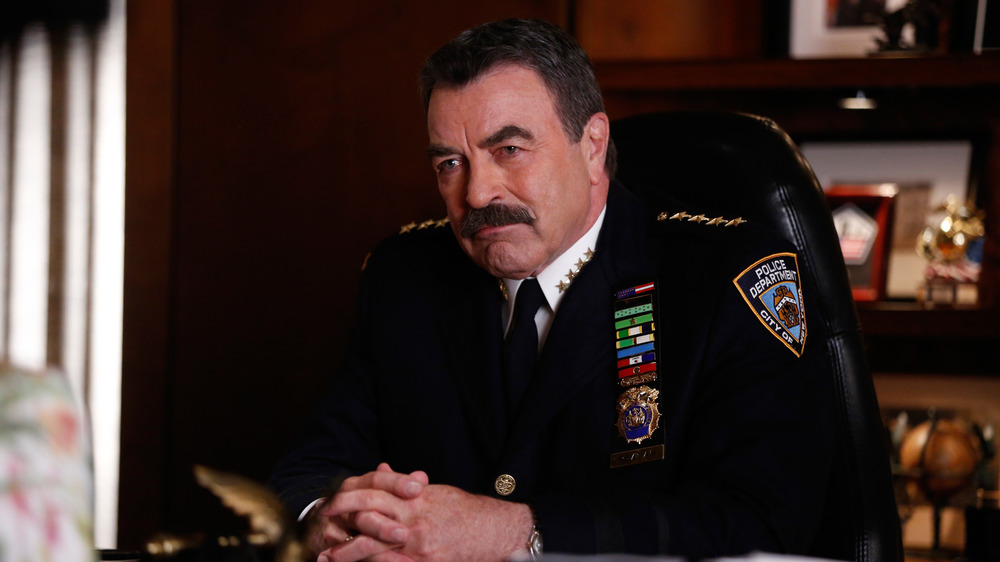
There’s also the vote for the police and crime commissioner which, I think, leaves most people cold because we don’t really understand the role. Now, if the candidate for police commissioner was Tom Selleck as Frank Reagan (below) in the American police procedural drama television series Blue Bloods, well, that might be different.

However, if you care about your local community and you’re registered to vote, please use it, and use it wisely. And don’t forget to take some form of photo ID with you, otherwise you won’t be allowed to cast your vote at all.