It’s a book!

Thrilled to announce the safe arrival of a book.

It’s Born & Bred: Stories of Then and Now in Broadwindsor, Dorset.

Featuring lots of old photos and interviews with locals, the 120-page book was produced by me for Windrose Rural Media Trust, for which I act as voluntary co-ordinator.

It’s available from the community pub and community shop, and also directly from me. I have to send a copy to the British Library, now that the international standard book number (ISBN) has been registered, so, in theory, people should be able to order it from book shops.

It’s been a long gestation and a difficult birth – my designer was beset with software problems and then a car crashed into a tree, causing him and thousands of others in the area to lose their internet for several days.

But it’s here, and the feedback has been lovely. It’s been a privilege to hear local people’s stories of their childhood and how the village used to be.

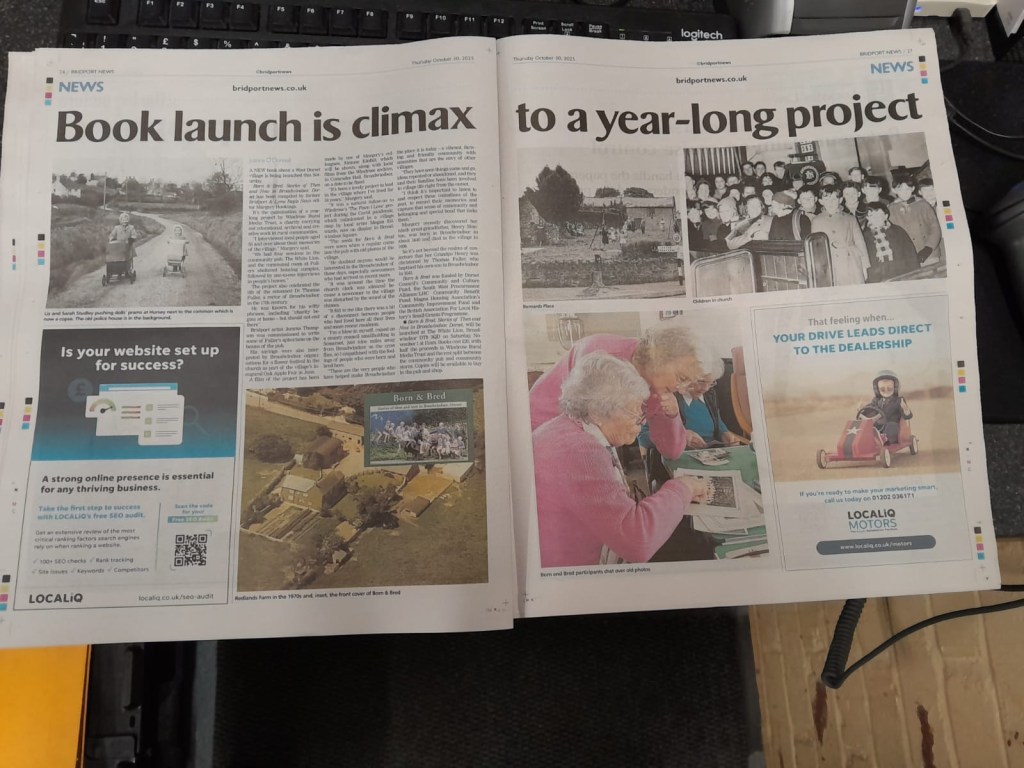
I even had a double page spread in the local paper.

All sale proceeds go to the pub, the shop and to Windrose, a registered charity.

The project is supported by grants from Dorset Council’s Community and Culture Fund, the South West Procurement Alliance/LHC Community Benefit FundMagna Housing Association’s Community Improvement Fund, and the British Association for Local History’s Small Grants Programme.

Raise a song of harvest home

Tractors are hauling high-sided trailers full of maize through the village.

It’s the day after the annual village Harvest Supper which this year was held, appropriately on National Farmers’ Day. Until last night, I had never heard of it.

It was a question in a quiz about Dorset and countryside miscellany. Our table did rather well, despite not knowing the height of the Cerne Giant (180 feet), Britain’s tallest and best-known chalk hill figure, or the number of one of the loveliest routes in the country – the coast road between Bridport and Beaminster. (It’s the B3157.)

We did know the name of three assorted cauliflowers (an educated guess), where Dorset’s Chesil Beach starts and ends (West Bay to Portland) and where Frankenstein author Mary Shelley is buried (Bournemouth).

But nobody in the whole room knew the date of National Farmers’ Day, even the handful of working and retired farmers who turned out for the feast in our village hall.

Our table guessed Lady Day (25 March), when, traditionally, farm tenancies are renewed and rents are due, but we also thought it could have been Michaelmas (29 September), as that quarter day falls in the harvest season.

It was neither.

It was 12 October. Apparently.

When I got home I looked it up, suspecting National Farmers’ Day might be an American invention.

According to Wikipedia, it’s marked on different dates around the world. The article states goes on to say that it’s held on 12 October in the USA. But there was no mention of the UK at all.

That’s probably because every day is farmers’ day – they’re always working.

Anyway, it’s too late for a steward’s inquiry and we did have a wonderful evening, with fabulous food, served with smiles and grace by Mrs Bancroft and her hardworking team.

I was asked by The Parson’s Daughter to sing with her the opening note to Come Ye Thankful People, Come because our tuneful vicar was away.

We won a bottle of wine on the raffle, were entertained by our village Gallery Quire, resplendent in Thomas Hardy-era costumes, and bought a bag of squashes and Scotch Bonnet chilli peppers, which look beautiful and quirky but will no doubt blow our socks off.

Hats off to all those involved in putting on the Harvest Supper. Long may this lovely tradition continue.

Church bell story chimes with petition organiser

Well, it seems neither the local newspapers nor the BBC is interested in the village bells debacle in my village.

It’s no longer newsworthy.

This is probably because the silencing of church clocks chiming is now commonplace all over the country. More of that later.

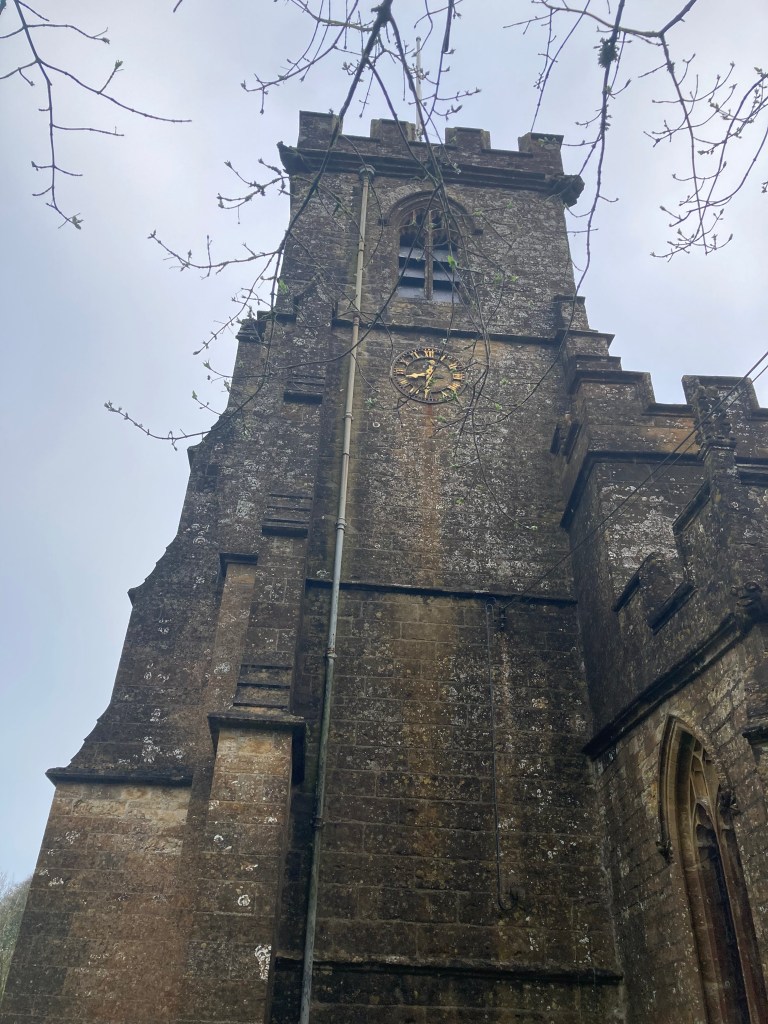
You’ll recall from my blog post of 18 March that the church clock stopped its hourly chiming, just two days after it was repaired.

A village resident complained about the hourly chiming – possibly having moved in when the clock wasn’t working – so the church stopped it completely.

The parochial church council has now reached a compromise solution to fit a silencer so that the clock chimes only between the hours of 6am and 9pm. This will be at a cost of around £800 rather than the original estimate of well over £2,000.

‘The feeling by many members of the PCC that, although the aim of the Church in the village was to “make Jesus known,” it was not felt necessary to remind everybody of his presence throughout the night,’ the PCC said in a statement.

So all’s well that ends well. Or not, as many local people are still unhappy that one complaint can stop the village clock chiming at all.

Without getting all Wicker Man and pitchforks at dawn – and there are far bigger problems and threats to democracy in the wider world – it can seem like rural life is under threat when some newcomers complain about things like the sound of church bells, animal smells, mud on the road and farmers working through the night.

The chiming of church bells is an ongoing problem. There was a similar issue recently in Witheridge, Devon, and also just down the road in the same county at Kenton in 2021.

All over the country, the church powers-that-be are worried about being slapped with noise abatement orders by their local councils. More and more clocks in towns and villages have stopped chiming .

I’ve just been contacted by a woman in Sandwich, Kent, where the night-time chiming of the bells was stopped in 2017 after one complaint by a neighbour.

June Summerhayes saw my blog and asked me to support her petition to the government calling for clock chimes to be exempt from noise abatement regulations.

I’ve signed it and told her I would help publicise her campaign. Understandably, she’s rather dismayed that, at the time of writing, only 85 people have signed so far.

You can add your signature to the petition here.

Mrs Summerhayes says: ‘Recognise the special place that clock chimes have in British life and history. Many churches have had to silence night time clock chimes because a single person, or a few people have complained. We believe this is unjust if the majority support the chimes.

‘We want noise abatement regulations to be amended so that they do not apply to clock chimes. This should also mean that any previously issued noise abatement orders in respect of clock chimes cease to have effect.’

At 10,000 signatures, the government will respond to this petition. At 100,000 signatures, the petition will be considered for debate in Parliament.

A bit of a ding dong

The church bells are still silent in Lush Places.

Meanwhile, I’m in France where the church bells in our village chime the hour twice, every hour (it’s about to strike three o’clock and they’ll go dong, dong, dong. And then a break and then dong, dong, dong again).

But the bells here do shut up at night. However, during the day, at noon and at seven o’clock, they chime until they’re fit to burst, calling in the workers from the fields for lunch and evening meal respectively.

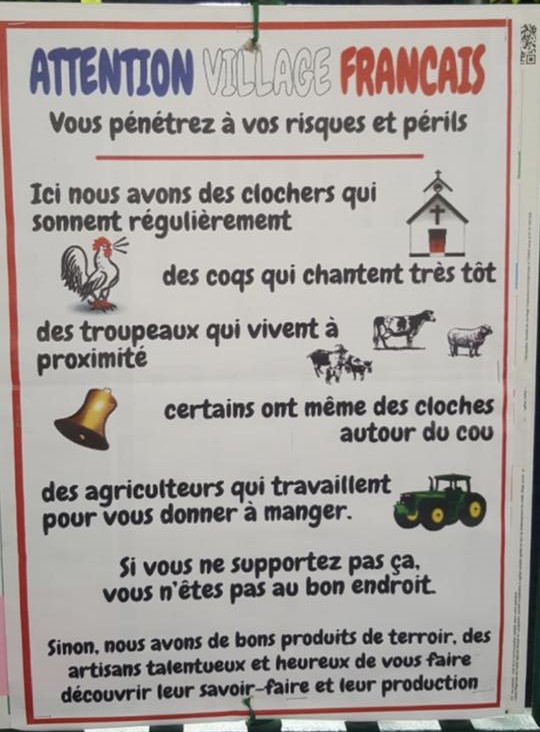
Last week, a former colleague reminded of a notice I’ve seen in many French villages, drawing outsiders’ attention to the perils of rural life.

This is the country where village signs up and down the land have been turned on their heads. This latest farmers’ protest alludes to having their own lives turned upside down by contradictory instructions. See the BBC story here.

I hope a solution can be found to the silencing of our village bells back in Dorset.

And wouldn’t it be wonderful if, in addition to the automatic hourly chiming being restored, a new team of bellringers steps forward to pull the ropes on Sundays and high days and holidays?

The bells aren’t rung on a Sunday at the moment because there’s no tower captain nor regular team of ringers.

It would be lovely if the positive outcome of the silence of the bells story was that volunteers joined forces for bellringing to happen once again.